
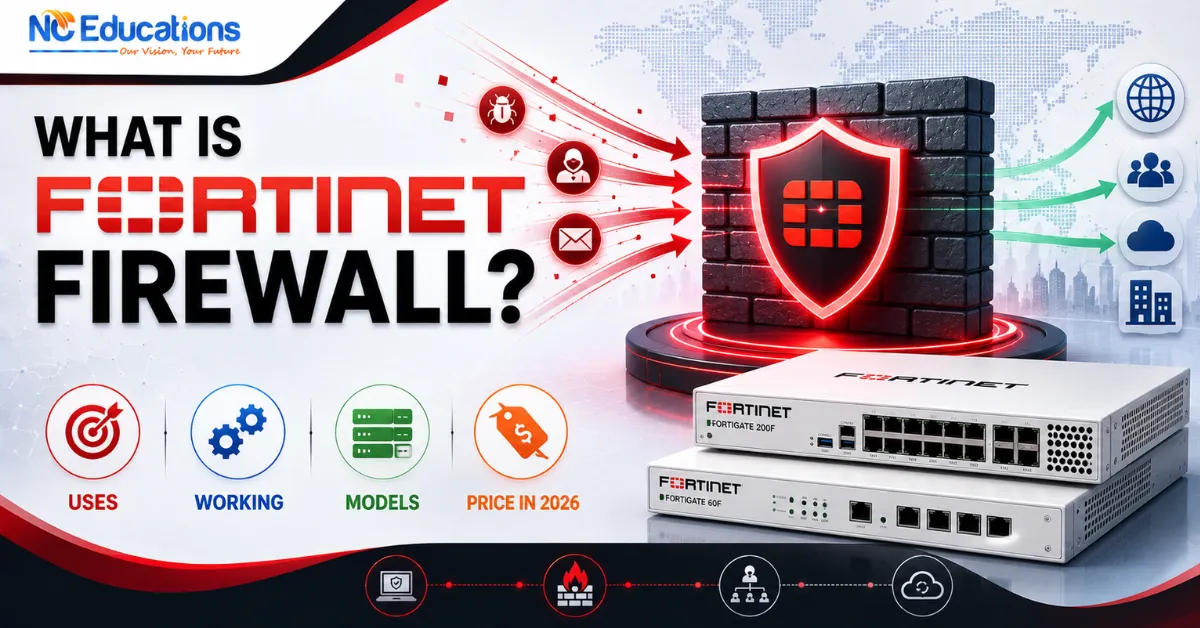
What is Fortinet Firewall?: A Fortinet firewall is a next generation firewall that provide network security. It is a high performance system developed by Fortinet and also known as FortiGate firewall. It works as a security barrier between a trusted internal network and external networks such as the internet. The firewall check the traffic and decided to allow or block as per pre defined security rules.
Fortinet firewalls are commonly used by large businesses, schools, government organizationsand, data centers & more. It provides features like firewall protection, intrusion prevention, antivirus, web filtering, VPN, and threat detection.
Fortinet’s firewall technology is commonly known as FortiGate. It combines traditional firewall, intrusion prevention, antivirus, application control, and web filtering. It comes in virtual software form or with physical hardware (FortiGate appliance) depending on needs. It is a big tech uses by many thus it create so many job opportunities for professionals who understand and manage fortinet.
In this artcile we are going to discuss on this firewall, its basic to advance, uses, works, learning, training, certification & career scopes. This is going to be in detailed, easy language and updated information for year 2026.
Fortinet Firewall Highlights
| Category | Details |
| What is Fortinet? |
A cybersecurity company that provides network security products.
|
| Firewall Product |
FortiGate Firewall
|
| Used For |
Blocking cyberattacks, controlling internet access, VPN connectivity, and protecting company networks.
|
| Where Used |
IT companies, banks, hospitals, government offices, data centers, and cloud environments.
|
| Course/Training |
Provied to teach professional about fortinet
|
| Beginner Training |
Fortinet Certified Fundamentals (FCF) learning path.
|
| Advanced Training |
FortiGate administration and FortiOS configuration.
|
| Certification |
Fortinet Certified Fundamentals (FCF), Fortinet Certified Associate (FCA), and advanced professional certifications.
|
| Exam Cost |
Between $200 to $800 USD (varies by certification choosed)
|
| Practical Learning |
Practice firewall policies, NAT, VPN, routing, and security profiles in a lab.
|
| Career Opportunities |
Firewall Administrator, Network Security Engineer, and SOC Analyst.
|
| Difficulty Level |
Beginner-friendly to start then advanced configuration requires networking knowledge.
|
| Official Website |
What Does a Fortinet Firewall Actually Do?
A Fortinet firewall primarily do below tasks:
- Enforces security policy at a network boundary – perimeter, branch, data centre, or cloud
- Combines multiple security functions (firewall, IPS, antivirus, web filtering, application control) in one platform, historically referred to as Unified Threat Management (UTM), now marketed as NGFW capability
- Offloads resource-intensive processing to dedicated hardware chips rather than the general-purpose CPU alone
- Integrates with other Fortinet products (switches, access points, endpoint agents) through what Fortinet calls the Security Fabric, enabling automated, coordinated responses across the network
- Receives continuously updated threat intelligence from FortiGuard Labs
Fortinet vs. FortiGate: Clearing Up the Naming
Fortinet is the company. FortiGate is the firewall product line. This distinction matters because Fortinet also sells a wide portfolio of adjacent products – FortiSwitch, FortiAP (wireless access points), FortiManager and FortiAnalyzer (centralised management and logging), FortiClient (endpoint agent), FortiMail, FortiWeb, and others – that are frequently discussed alongside FortiGate but are separate products. When people say “Fortinet firewall,” they mean FortiGate specifically.
FortiOS: The Operating System Behind Every FortiGate
FortiOS is the operating system that runs on every FortiGate appliance and virtual machine. Every FortiGate – physical appliance or virtual machine – runs FortiOS, which is what allows policy concepts to carry across form factors in a similar way to how PAN-OS does for Palo Alto’s product line.
- The Security Processing Unit (SPU) Architecture: The architectural idea behind FortiGate’s performance claims is the Security Processing Unit, or SPU.
- CPU: It is the core processing unit responsible for executing firewall operations, packet processing, and running various security services, and FortiGate uses multi-core CPUs to handle high-throughput traffic and complex security functions.
- Network Processors (NP): FortiGate includes specialised network processors such as the FortiASIC NP6 and NP7 which are dedicated to offloading and accelerating specific tasks like packet forwarding and encryption/decryption, enhancing performance and scalability.
- Content Processors (CP): Most FortiGate models contain Content Processors (CPs) that accelerate common, resource-intensive security-related processes, with tasks offloaded to them as determined by the main CPU, and capabilities varying by model.
- System-on-a-Chip (SoC) Models: Some FortiGate models, particularly smaller branch/SD-WAN-oriented units use a System-on-a-Chip design instead of separate discrete NP/CP chips.
How Is Traffic Actually Inspected?
When traffic matches a security policy with security profiles enabled, Fortinet inspects it using either flow-based or proxy-based inspection. Flow-based inspection checks traffic in real time, while proxy-based inspection can handle traffic through web proxy functions.
Some of this work can be accelerated by FortiGate’s NP/CP security processors, while other tasks run on the main CPU.
For a network engineer, the key point is simple: the inspection mode, enabled security features, and hardware offloading all affect FortiGate’s actual performance and throughput.
Deployment Modes: NAT Mode vs. Transparent Mode
A FortiGate (or a Virtual Domain within one – see below) typically operates in one of two modes:
- NAT/Route mode – the firewall acts as a Layer 3 router, performs network address translation, and is visible to the network as a routed hop. This is the most common mode for perimeter and internet-edge deployments.
- Transparent mode – the firewall acts more like a Layer 2 bridge, inspecting traffic without requiring readdressing of the existing network, which makes it easier to insert into an existing topology for segmentation or inspection purposes.
Virtual Domains (VDOMs)
VDOMs let you split one FortiGate into multiple separate virtual firewalls. Each VDOM can have its own policies, routing, and administrators. This is useful for service providers, large companies, or labs that need separate network environments without buying separate firewalls.
The Fortinet Security Fabric
The Security Fabric connects Fortinet products so they can work together. For example, if FortiClient detects a compromised device, it can inform FortiGate and help isolate the device quickly. So, FortiGate is not just about the firewall itself. Its bigger advantage is how it works with FortiSwitch, FortiAP, FortiClient, FortiAnalyzer, and FortiManager to provide a more connected and centrally managed security setup.
FortiGate vs. Traditional Firewall
| Aspect | Traditional / Legacy Firewall | FortiGate NGFW |
| Processing model | General-purpose CPU handles everything | Dedicated NP (networking) and CP (security/content) hardware offload alongside the CPU |
| Security functions | Often separate appliances or add-ons | Firewall, IPS, antivirus, web filtering, and application control consolidated in one platform |
| Multi-tenancy | Typically one policy set per appliance | VDOMs allow multiple independent virtual firewalls on one physical box |
| Ecosystem integration | Firewall operates largely in isolation | Security Fabric coordinates automated response with switches, access points, and endpoints |
| Deployment flexibility | Often fixed to one mode | Can run NAT/route mode and transparent mode simultaneously across different VDOMs |
Common Mistakes When Evaluating or Learning FortiGate
- Assuming all security processing is hardware-accelerated by default. Offloading depends on model, licensed features, and whether the configured inspection mode (flow-based vs. proxy-based) supports it – not every feature on every model benefits equally from NP/CP acceleration.
- Confusing Fortinet (the company/ecosystem) with FortiGate (the firewall product) when researching or comparing pricing and licensing.
- Treating VDOMs as a substitute for proper high-availability design. VDOMs solve multi-tenancy and policy segmentation; they don’t by themselves provide redundancy if the physical appliance fails.
- Studying outdated NSE certification material without checking the current program structure – see below.
Fortinet Certification Path: The NSE Program
If you are planning to earn a Fortinet’s certification then path for the Network Security Expert (NSE) program, structured as eight numbered levels that feed into named certification designations rather than one flat exam list:
| NSE Level(s) | Feeds Into | What It Covers |
| NSE 1–3 | Fortinet Certified Fundamentals (FCF) / Fortinet Certified Associate (FCA) | Foundational cybersecurity and threat-landscape concepts |
| NSE 4 (+ NSE 5) | Fortinet Certified Professional (FCP) | FortiGate firewall configuration and administration |
| NSE 6 (+ NSE 7) | Fortinet Certified Solution Specialist (FCSS) | Specialized Fortinet technologies beyond the core firewall (e.g., FortiMail, FortiWeb, FortiNAC) |
| NSE 8 | Fortinet Certified Expert (FCX) | The highest level – requires both a written and a hands-on practical exam |
Fortinet Certification Curriculum Structure
FortiGate’s real differentiator is its hardware-acceleration architecture and its role inside the wider Fortinet Security Fabric – so the strongest curriculum teaches those specifically, rather than treating FortiGate as a generic firewall with a different menu layout. Each module builds toward configuring, troubleshooting, and reasoning about a real Fortinet deployment.
Syllabus
| Module | Focus Area | What You’ll Learn |
| 1. FortiOS and NGFW Fundamentals | Platform architecture | What FortiOS does across every FortiGate form factor, and how FortiGate combines firewall, IPS, antivirus, application control, and web filtering into one platform |
| 2. SPU Hardware Acceleration | Performance architecture | How the CPU, Network Processors (NP6/NP7), and Content Processors (CP9) divide security workloads – and why not every feature on every model benefits equally from hardware offload |
| 3. Inspection Modes: Flow-Based vs. Proxy-Based | Traffic inspection | Configuring flow-based (single-pass) versus proxy-based inspection, and how that choice affects which tasks get offloaded to NP/CP hardware |
| 4. Deployment Modes: NAT and Transparent | Network integration | Configuring NAT/route mode as a routed Layer 3 hop versus transparent mode as a Layer 2 bridge, including running both modes simultaneously across different VDOMs |
| 5. Virtual Domains (VDOMs) | Multi-tenancy | Partitioning a single physical FortiGate into multiple independent virtual firewalls, each with its own policies and routing – and why VDOMs solve segmentation, not high availability |
| 6. High Availability | Resilience | Designing FortiGate HA so a single appliance failure doesn’t take down the network – and why VDOMs alone aren’t a substitute for proper HA |
| 7. The Fortinet Security Fabric | Ecosystem integration | Coordinating automated response across FortiSwitch, FortiAP, and FortiClient – for example, automatically quarantining a compromised endpoint at the switch port when FortiClient detects it |
| 8. Centralized Management and Logging | Operations at scale | Using FortiManager for centralized policy management and FortiAnalyzer for centralized logging and analytics across multiple FortiGate deployments |
| 9. Troubleshooting and Log Analysis | Operations | Diagnosing policy hits/misses, inspection-mode issues, and hardware-offload behavior using FortiGate’s logging and diagnostic tools |
Who Should Go for Fortinet Certification?
A strong fit if you’re:
- A network or security engineer who already understands firewall and stateful-policy fundamentals and wants FortiGate-specific, hands-on configuration skills
- An SD-WAN or branch-network engineer, since Fortinet has a strong presence in SoC-based branch and SD-WAN-oriented deployments
- A security operations professional who needs to interpret Fortinet logs and coordinate Security Fabric-driven responses
- Coming from a Cisco networking or security background (CCNA, CCNP Security) and want to add a second NGFW vendor – zones, stateful policy, IPS, and VPN concepts transfer, but FortiOS syntax, licensing, and Security Fabric integration are Fortinet-specific and need dedicated practice
Worth a second look if you’re:
- If you are new to firewalls and networking generally as this course assumes you already understand basic firewall and networking concepts.
- Only interested in a single narrow NSE exam number without wanting to understand how the broader NSE 1-8 ladder as it is itself is a big career making skills.
Fortinet Training for Cisco Security Professionals
If your background is Cisco networking or security (CCNA, CCNP Security), the underlying concepts – zones, stateful policy, IPS, VPN – transfer conceptually to FortiGate. What doesn’t transfer automatically is FortiOS’s configuration syntax, licensing structure, and Security Fabric integration – those are Fortinet-specific and need dedicated, hands-on practice rather than being assumed from Cisco experience alone.
Why Choose NC Educations?
We, NC Educations offer Fortinate Training is led by Atin Gupta, a CCIE Security-certified trainer (CCIE Security #61100), with more than 8,000 students trained, 24/7 virtual lab access, flexible batch scheduling for working professionals, and placement assistance to help connect classroom learning to real opportunities. If you want to build hands-on firewall and network security skills, it’s worth checking current course availability directly with NC Educations to find the training path that fits where you are today.
Most Asked Question of Fortinet
Is Fortinet the same as FortiGate?
Ans. No. Fortinet is the company; FortiGate is its firewall product line, running on the FortiOS operating system. Fortinet also sells many other products (FortiSwitch, FortiAP, FortiMail, FortiWeb, FortiClient, and more) that are separate from the firewall itself.
What is a Security Processing Unit (SPU)?
Ans. SPU is Fortinet’s umbrella term for its purpose-built hardware acceleration approach, which includes network processors (NP) for packet forwarding and encryption/decryption, content processors (CP) for security-intensive tasks like SSL/TLS decryption, IPS, and antivirus, and, on some smaller models, a combined System-on-a-Chip (SoC) design.
What is the difference between NAT mode and transparent mode on a FortiGate?
Ans. NAT mode operates the Fortinet firewall as a routed Layer 3 hop with address translation, while transparent mode operates more like a Layer 2 bridge that inspects traffic without requiring network readdressing. Different VDOMs on the same physical FortiGate can run in different modes at the same time.
What is a VDOM iin Fortinet?
Ans. A Virtual Domain (VDOM) lets a single physical FortiGate be partitioned into multiple logically independent virtual firewalls, each with its own policies and routing, which is useful for service providers and organisations that need administrative separation without deploying separate hardware.
Which Fortinet certification should a beginner start with?
Ans. The NSE 1 to NSE 3 certification of Fortinet cover foundational concepts, and NSE 4 is the standard entry point for hands-on FortiGate configuration skills. So beginner should start with these.
Related Articles
12 thoughts on “What is Fortinet Firewall?: Used For, How it Works, Models with Comparison, Role in Cyber Security & Price in 2026”