
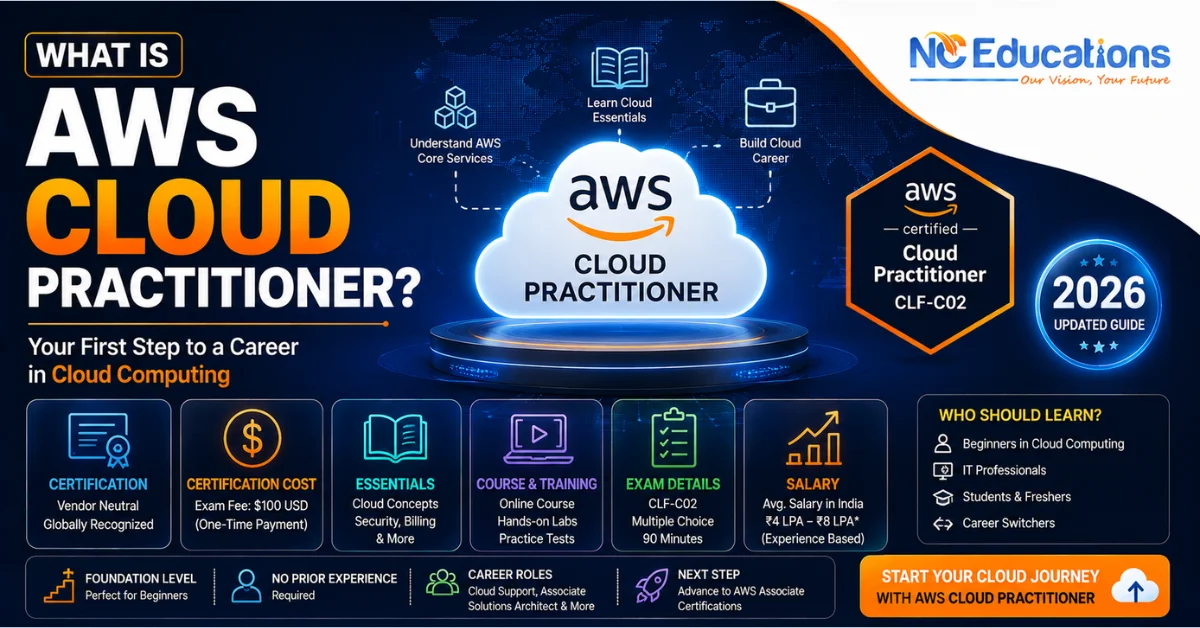
AWS Cloud Practitioner (exam code CLF-C02) is Amazon Web Services’ foundational level certification. It is designed to validate an overall understanding of the AWS Cloud independent of any specific technical job role. It’s the entry point into AWS’s certification structure and career paths which sits just below the Associate-level certifications. This does not required prior AWS experience or technical knowledge.
If you are someone curious about AWS Cloud Practitioner CLF-C02 or the one who wanted to make a career out of it. This article will help you to understanding in this certification, what you will study in this, exam cost, hardness level, average expected salary, is it suitable for fresher, career options and more. Read full articles to know more.
AWS Cloud Practitioner CLF-C02 Highlights
| Certification Tier |
Foundational Level (Entry)
|
| Primary Exam |
AWS Certified Cloud Practitioner (CLF-C02)
|
| Prerequisite Path |
No prior technical or cloud background is required to take this exam.
|
| Core Domain Focus |
Understanding of Cloud Concepts, Security and Compliance, Cloud Technology and Services, and Billing, Pricing, and Support.
|
| Key Technical Skills |
General knowledge of core AWS services (EC2, S3, RDS, Lambda), AWS Shared Responsibility Model, and billing tools.
|
| Best Suited For |
Non-technical professionals (sales, marketing, HR, finance), aspiring cloud students, and IT beginners.
|
| Job Roles |
Junior Cloud Support, Technical Account Manager (entry-level), Sales Operations, Business Development, or Product Manager.
|
| Average Salary |
India: ₹5,00,000 – ₹9,00,000 per year
Global / US: $85,000 – $110,000 per year. |
| Official Exam Cost | Standard: $100 USD |
| Exam Fees in India | INR 9,050 to INR 10,250 + GST |
| Exam Questions |
65 in total
|
| Exam Duration | 90 minutes |
What is AWS Cloud Practitioner?
AWS Certified Cloud Practitioner CLF-02 is the entry level certification of Amazon Web Services. It covers the study of broad knowledge of cloud concepts, AWS core services, security and compliance basics, and billing/pricing. It is the entry point for someone wanted to make career in AWS without any coding skills.
Amazon have an exam named “AWS Certified Cloud Practitioner CLF-C02” and those passed this exam is awarded this certification. It is like a basic overview study of overall amazon wer services without getting deeper hands in technicalities.
It is idea for someone who don’t have any prior knowledge of AWS but wanted to works it its environments.
What AWS Cloud Practitioner Actually Validates?
According to AWS’s own exam guide, the certification confirms a candidate can:
- Explain the value of the AWS Cloud
- Understand and explain the AWS shared responsibility model
- Understand the AWS Well-Architected Framework at a conceptual level
- Understand security best practices
- Understand AWS Cloud costs, economics, and billing practices
- Describe and position core AWS services across compute, network, database, and storage
- Identify appropriate AWS services for common use cases
Just as importantly, AWS explicitly states what the exam does not test: coding, designing cloud architecture, troubleshooting, hands-on implementation, or load/performance testing. This is a conceptual, breadth-first certification – not a hands-on technical assessment.
AWS Cloud Practitioner Exam CLF-C02 Syllabus
The syllabus of CLF-C02 exam is devided into four weighted domains:
| Domain | Weight | Focus |
| Cloud Concepts | 24% | Benefits of cloud computing, cloud deployment models, AWS Well-Architected Framework, AWS global infrastructure |
| Security and Compliance | 30% | Shared responsibility model, AWS Identity and Access Management (IAM) basics, compliance concepts, security best practices |
| Cloud Technology and Services | 34% | Core AWS services across compute (EC2, Lambda), storage (S3, EBS), databases (RDS, DynamoDB), networking (VPC), and how they’re commonly used together |
| Billing, Pricing, and Support | 12% | AWS pricing models (On-Demand, Reserved, Spot), billing/cost management tools, AWS Support plan tiers |
AWS CLF 02 Cost and Exam Format
- Cost: The total cost of AWS Cloud Practitioner CLF-C02 Exam is $100 USD (subject to regional tax and currency adjustments).
- Question count: The test consists of 65 total questions (50 scored, 15 unscored for AWS’s own question-testing purposes; unscored questions aren’t identified during the exam).
- Question types: It has multiple choice (one correct answer from four options) and multiple response (two or more correct answers from five or more options).
- Duration: 90 minutes
- Passing score: You need to score 700 out of a scaled 100-1,000 range, using a compensatory scoring model to pass. Which means meaning you don’t need to pass each domain individually, only the overall exam.
- Validity: The certification is valid 3 years from the date of issue, after which recertification is required.
- Delivery: Available at Pearson VUE testing centres or via online proctoring.
Unanswered questions are scored as incorrect, so there’s no benefit to leaving a question blank if you’re unsure then an educated guess is always better than no answer.
Who Should AWS Cloud Practitioner Exam?
AWS explicitly designed Cloud Practitioner as role-agnostic. It’s genuinely useful for two distinct groups:
- Non-technical professionals – sales, marketing, product/project management, and finance roles that regularly interact with AWS-based products, budgets, or client environments benefit from the vocabulary and conceptual grounding this certification provides, even without ever touching the AWS console in a hands-on capacity.
- Technical beginners – IT professionals, students, and career changers who are new to AWS specifically (even if experienced in other areas of IT, like networking) get a low-stakes, low-cost way to build foundational AWS vocabulary before attempting Associate-level exams, which assume working familiarity with core services.
For networking professionals specifically, Cloud Practitioner’s Cloud Concepts and Cloud Technology domains overlap conceptually with ideas you likely already understand – network segmentation, security groups (Amazon VPC’s equivalent of firewall rule sets), and hybrid connectivity – making the certification easier to approach than for a true cloud novice.
Who Should Skip AWS CLF 02 Exam and Go Straight to Associate Level?
This is a genuine decision point, not a formality. If you already have meaningful hands-on AWS experience (roughly a year or more) or a strong general cloud computing background from another platform, skipping directly to AWS Certified Solutions Architect – Associate is a reasonable path – there’s no prerequisite requirement linking the two.
If you’re new to AWS specifically, even with strong IT fundamentals elsewhere, Cloud Practitioner is worth the relatively low time and cost investment: it builds the shared vocabulary and service-level awareness that Associate-level exams assume you already have, and passing it typically shortens overall Associate-level study time rather than adding to it.
Common Mistakes When Preparing AWS Cloud Practitioner
- Underweighting Security and Compliance. At 30% of the exam, this domain is nearly as heavily weighted as Cloud Technology and Services – treating it as a minor section is one of the most common reasons candidates underperform.
- Memorising service names without understanding use cases. The exam tests whether you know when to use a service (e.g., recognising that “automatic scaling based on demand” points to elasticity/Auto Scaling), not just what each service is called.
- Skipping the official exam guide. Third-party study material is useful for practice, but AWS’s own exam guide defines exactly what’s in and out of scope – skipping it means studying blind to the actual boundaries of the test.
- Assuming the exam requires technical depth. Because it’s role-agnostic, the exam deliberately avoids deep technical implementation questions – over-preparing on hands-on configuration at the expense of conceptual breadth wastes study time relative to what’s actually tested.
Why Choose NC Educations For AWS Cloud Practitioner Preperation?
Understanding what Cloud Practitioner covers is the first step – building real familiarity with AWS’s console, core services, and security model is what actually prepares you to pass with confidence. NC Educations‘ AWS training program is built around that hands-on requirement:
- CCIE-certified trainer – Atin Gupta, CCIE Security #61100, brings a networking-first teaching approach that’s especially useful for translating AWS’s networking and security concepts (VPC, security groups, IAM) into terms familiar from traditional network security.
- 8,000+ students trained across NC Educations’ Cisco and cloud/security programs.
- 24/7 virtual lab access – get hands-on practice with core AWS services on your own schedule, not just during scheduled class time.
- Placement support for learners moving into cloud-related roles.
- Flexible batch scheduling to fit around existing work commitments.
Most Asked Questions Related to AWS Cloud Practioner Certification
Does AWS Cloud Practitioner require coding knowledge?
Ans. No. AWS explicitly excludes coding, architecture design, and hands-on troubleshooting from the exam’s scope. It tests conceptual understanding of AWS Cloud value, core services, security, and billing.
How many questions are on the AWS Cloud Practitioner exam?
Ans. There are 65 total questions in 90 minutes for AWS Cloud Practioner. Out of which 50 count toward your score, and 15 are unscored questions AWS uses to evaluate future exam content, though you won’t know which is which during the test.
What certification should I pursue after Cloud Practitioner?
Ans. AWS’s own guidance points toward Associate-level certifications next – commonly AWS Certified Solutions Architect – Associate, AWS Certified Developer – Associate, or AWS Certified SysOps Administrator – Associate, depending on your career direction.
Is AWS Cloud Practitioner worth it for a non-technical role?
Ans. Yes, particularly for sales, project management, or finance professionals working around AWS-based products or budgets – it provides working vocabulary and conceptual grounding without requiring hands-on technical skills.
How long is the AWS Cloud Practioner certification valid?
Ans. Three years from the date you pass, after which recertification (retaking the current exam or passing a higher-level AWS certification) is required to maintain active status.
Related Articles
8 thoughts on “What is AWS Cloud Practitioner?: Certification Cost, Essentials, Course, Exam, Salary, CLF c02, Training & other details 2026”