
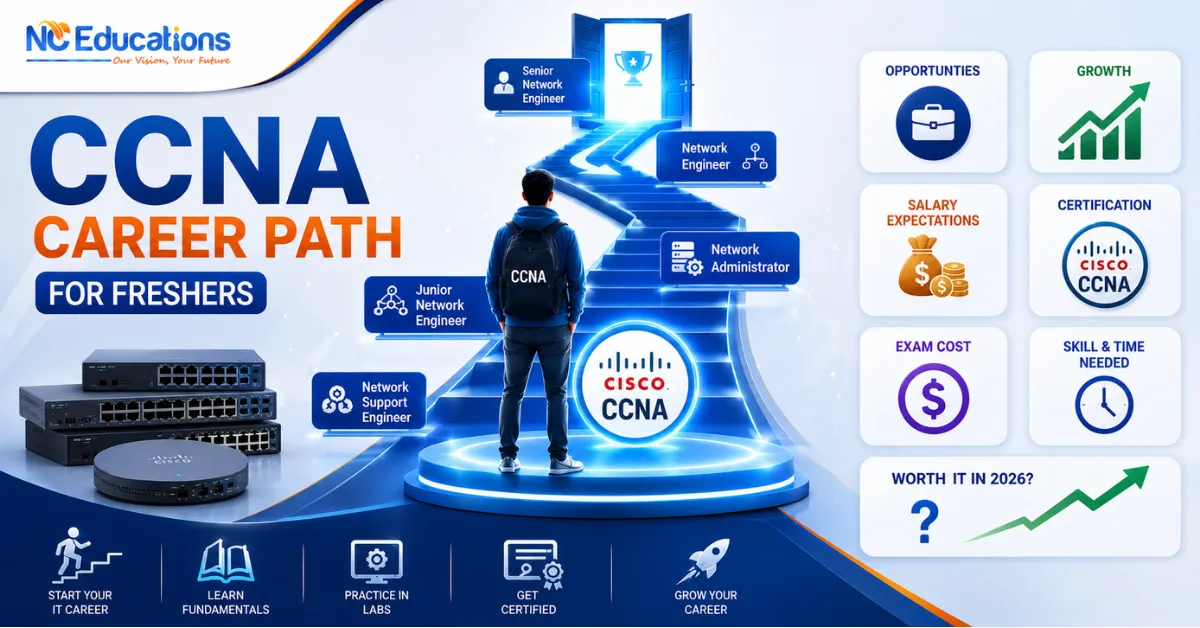
CCNA career path leads to a broad entry-level roles like Network Support Engineer, NOC Engineer, Junior Network Engineer, and Technical Support Associate, typically across telecom, banking, healthcare, cloud services, and government IT teams.
From there, the CCNA 200-301 career path branches into four directions based on your interest: core networking (CCNP Enterprise → CCIE), security (CyberOps Associate → CCNP Security), cloud networking (AWS/Azure certifications), or automation (Python, Ansible, CCNP Automation). With consistent upskilling, most professionals reach a mid-level engineering role within 2-3 years and a senior/architect-level role within 5-8 years.
This guide walks through every stage of that Cisco Certified Network Associate (CCNA) path in detail. Get information of the roles, the industries, the certifications, and the salary growth and how NC Educations structures its training around it.
Related Post: What is CCNA?
CCNA Career Path 2026
Most confusion around the “CCNA career path” comes from treating CCNA as if it certifies you for one specific job. It doesn’t. CCNA validates the core language of networking – IP addressing, subnetting, routing, switching, wireless basics, security fundamentals, and (as of the current exam) automation and programmability – the baseline skill set used across support, operations, administration, security, cloud, and field engineering roles alike.
That breadth is exactly what makes it valuable: CCNA doesn’t lock you into one direction; it qualifies you to choose one once you’ve had some real exposure to the work.
Stage 1: Entry-Level Roles Right After CCNA
With CCNA in hand, these are the roles you’re realistically positioned for:
- Network Support Engineer – first-line troubleshooting, connectivity issues, ticket-based support
- NOC (Network Operations Centre) Engineer – monitoring network health, escalating incidents, shift-based operations
- Junior Network Engineer – assisting with configuration, VLAN setup, basic routing changes under supervision
- Technical Support Associate / Helpdesk Technician – broader IT support with a networking specialisation
- IT Infrastructure Intern/Trainee – common at larger companies and MSPs as a structured entry point
None of these requires years of experience – they’re built for exactly the profile CCNA creates: someone who understands how networks work and can be trusted with real, supervised production tasks from day one.
Stage 2: Industries That Hire CCNA-Certified Professionals
CCNA isn’t tied to one sector. It shows up as a baseline requirement across:
- Telecommunications – building, managing, and maintaining communication networks
- Banking & Financial Services – securing and maintaining always-on transaction networks
- Healthcare – supporting connected medical systems and compliant network infrastructure
- Cloud Services & IT Product Companies – network operations for hosting and SaaS platforms
- Government & Public Sector – infrastructure roles requiring standardised, auditable networking practices
- Managed Service Providers (MSPs) – supporting multiple client networks simultaneously, a common launchpad for fast, varied experience
This spread matters practically: if hiring slows in one sector, a CCNA-certified profile isn’t stuck – the same core skill set transfers across all of them.
Stage 3: Choosing Your Specialisation
Once you have some hands-on experience, the CCNA career path forks into four common directions. None is objectively “better” – the right one depends on what kind of work you actually enjoy.
| Direction | Next Certification | What the Work Looks Like |
| Core Networking | CCNP Enterprise → CCIE Enterprise Infrastructure | Designing, building, and troubleshooting routed/switched infrastructure at scale |
| Security | CyberOps Associate → CCNP Security or CCNP Cybersecurity | SOC analysis, firewall/VPN administration, threat detection and response |
| Cloud Networking | AZ-104 (Azure) or AWS networking certifications | Hybrid connectivity, VPC/VNet design, cloud-to-on-prem integration |
| Automation | CCNA Automation → CCNP Automation | Python/Ansible-driven configuration, NetDevOps, infrastructure-as-code for networks |
How to decide: Pay attention to what you gravitate toward in your first 6-12 months on the job. Enjoy digging into firewall logs and incident response? Security is a natural fit. Prefer scripting repetitive config tasks? Automation. There’s no wrong branch – each one keeps the CCNA foundation relevant, just applied differently.
Stage 4: Mid-Level Roles and the Next Certification
With 1-3 years of experience and a specialisation certification (typically CCNP-level) in progress or completed, roles open up such as:
- Network Engineer / Network Administrator – full ownership of routing, switching, and change management
- Security Analyst / Network Security Engineer – firewall policy, VPN administration, incident response
- Cloud Network Engineer – hybrid cloud connectivity across AWS, Azure, or GCP
- Network Automation Engineer – Python/Ansible-driven configuration management at scale
This is also the stage where CCNP (in whichever track you chose) becomes the credential that actually moves your salary and title, not just your day-to-day responsibilities.
Stage 5: Senior and Leadership Roles
With 5+ years of experience and advanced certifications (CCNP consistently, CCIE for the technical track), the CCNA career path leads toward:
- Senior Network Engineer / Network Consultant – architecture-level decisions, mentoring junior engineers
- Security Architect – designing enterprise-wide zero-trust and network security strategy
- Network Architect – end-to-end infrastructure design for large or multi-site organisations
- IT Infrastructure Manager / Team Lead – for professionals who move toward people leadership rather than pure technical depth
At this stage, career growth depends less on any single exam and more on demonstrated ownership of complex, high-stakes systems – certifications open the door, but track record keeps it open.
Skills Worth Building Alongside CCNA
To get a good career wtih CCNA you need to build some addittional skills that are demanded by the employers. They expect these even at a mid-career stage, regardless of which specialisation you pick:
- Scripting/automation basics – even simple Python or Ansible scripts to reduce manual configuration work
- Cloud fundamentals – at least conversational familiarity with AWS or Azure networking concepts
- Security awareness – firewalls, VPNs, and zero-trust concepts, even outside a dedicated security track
- Documentation and communication – the ability to explain network changes clearly to non-technical stakeholders is consistently cited as a differentiator at promotion time
CCNA Career Path Salary Growth
Salary grows steadily as you move from certification to specialisation to seniority. Based on current industry benchmarks:
| Career Stage | Typical Profile | Annual Salary Range |
| Entry-Level (0-1 yrs) | CCNA-certified, Network Support/NOC role | ₹3 LPA – ₹6 LPA |
| Mid-Level (2-5 yrs) | CCNP-track, specialised (security/cloud/automation) | ₹7 LPA – ₹16 LPA |
| Senior/Expert (5+ yrs) | CCNP/CCIE with a strong specialisation | ₹18 LPA – ₹35+ LPA |
Figures are indicative and vary by employer, location, and specialisation – check current region-specific listings for the most accurate numbers. Internationally, the same relative growth pattern holds: entry-level roles typically start in the equivalent of the low-to-mid five figures (USD), rising well into six figures for experienced, specialised professionals in markets like the US, UK, and UAE.
Global Opportunities for CCNA Holders
CCNA is recognised well beyond India – it’s a common baseline requirement in networking job postings across the USA, UK, Canada, UAE, Singapore, and the broader Middle East, largely because Cisco infrastructure underpins such a large share of enterprise networks globally. That portability is one of CCNA’s underrated advantages: the same certification and skill set travel with you if you’re targeting an international role later in your career, not just a domestic one.
How NC Educations Helps You Build a CCNA Career Path?
Earning CCNA certification is the first step in building an actual career from the certifications and learned skills. This is the part where guidance matters most. That’s NC Educations created this path along with their 7+ years expertise in networking industry along with their CCIE level expert trainers that supports you in every stage of this path:
- CCNA training aligned to the current exam – including the network fundamentals, security, and automation/programmability content that shows up in real entry-level work, not just exam-pattern memorisation
- 24/7 virtual lab access – so you graduate having actually configured VLANs, routing, and troubleshooting scenarios, not just studied them
- Specialisation guidance – once you’re CCNA-certified, clear next-step tracks into CCNP Enterprise, CCNP Security, cloud (Azure), or SD-WAN, based on where your interests actually lie
- Resume and interview preparation – positioning your CCNA and lab experience clearly for the specific roles (NOC, network support, junior engineer) that hire at your stage
- Placement support – connections to relevant hiring opportunities and guidance through the application process, alongside flexible batch scheduling for working professionals
Training is led by Atin Gupta, CCIE Security #61100 – consistent with everything else in our course catalogue, this support is about making you genuinely competitive for each stage of the path above, not a promise of guaranteed placement.
FAQs Related to CCNA Career Path
Is CCNA enough to get a job?
Ans. Yes, for entry-level roles like Network Support Engineer, NOC Engineer, or Technical Support Associate. It’s a strong starting credential, not a ceiling – most professionals pair it with hands-on experience and a follow-up certification within 1-2 years.
What is the next certification after CCNA?
Ans. It depends on your direction: CCNP Enterprise for core networking, CyberOps Associate or CCNP Security for security, cloud certifications (like AZ-104) for cloud networking, or CCNA/CCNP Automation for network automation.
What jobs can I get with just CCNA?
Ans. Network Support Engineer, NOC Engineer, Junior Network Engineer, Technical Support Associate, and IT Infrastructure Trainee are the most common entry points.
Which field is best after CCNA – security, cloud, or automation?
Ans. There’s no single “best” – it depends on what you enjoy day to day. Security suits people who like incident response and defense; cloud suits those interested in hybrid infrastructure; automation suits people who enjoy scripting and reducing manual work.
How long does it take to grow from CCNA to a senior networking role?
Ans. Typically 5-8 years, moving through entry-level support roles, a mid-level specialisation (usually CCNP-level), and finally into senior engineering, architecture, or leadership roles backed by real production experience.
Also Read
5 thoughts on “CCNA Career Path 2026: For Freshers, Opportunities, Growth, Salary Expectations, Certification, Exam Cost, Skill & Time Needed, is it worth?”