
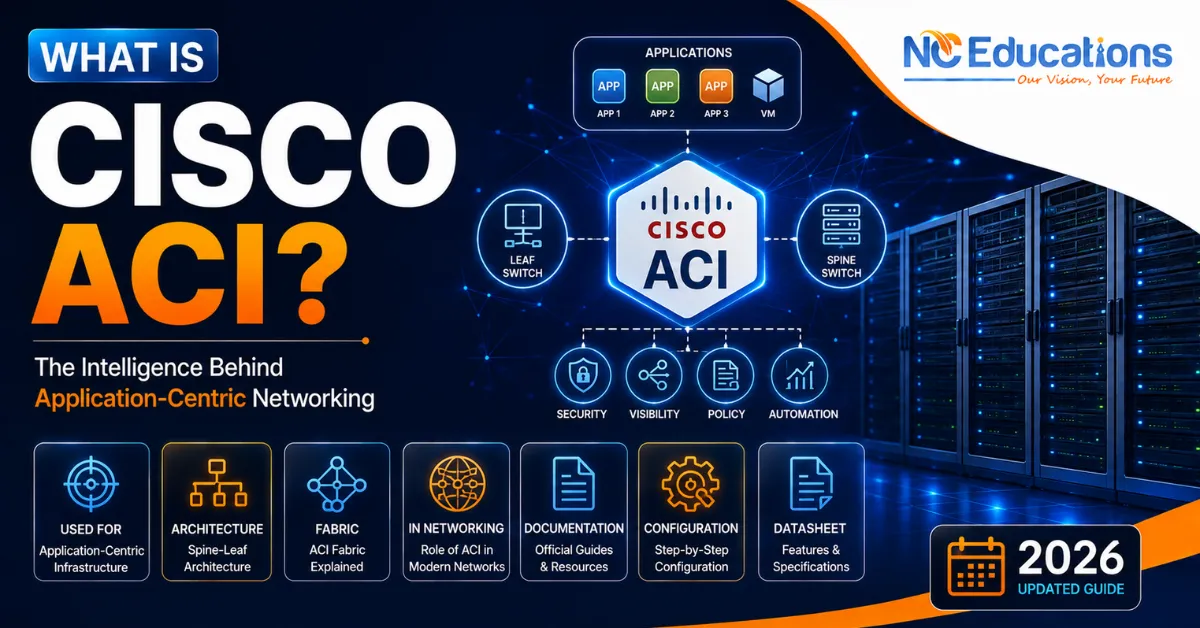
What is Cisco ACI 300-620?: Cisco ACI is a professional level exam that focuses on Cisco Application Centric Infrastructure in Networking. It validates persons skill for designing, configuring, managing, and troubleshooting ACI-based data center networks. It is a individual certification anyone can do to get Data Center Networking roles to earn upto INR 15.6 LPA.
The exam code is Ciscos 300-620 DCACI and main skills required to pass the test are ACI, APIC, Nexus, Spine-Leaf, EPG, VRF, Contracts and L3Out. It applies at data centres wide-area networks solve very different problems, and Cisco actually has a separate SDN solution for each – which is part of why “Cisco ACI 300-620” and “Cisco SD-WAN 300-415” get mixed up so often.
If you want to learn Cisco ACI to get certification and wanted to make a high earning career out of it or you’re a network engineer weighing wanted to whether data centre specialisation is worth pursuing. Then reading this 7 to 10 minutes guide of What Cisco ACI 300-620 actually is, what to do in it, career path, salary, cost and time to invest will be helpful.
What Is Cisco ACI?
Cisco Application Centric Infrastructure (Cisco ACI) Cisco’s professional level certification for Data center management. It is software-defined networking (SDN) solution for the data centres. ACI lets network teams define policies based on what applications actually need, and the fabric automatically applies those policies across the entire network – physical and virtual alike. It’s built around a centralised controller, called the APIC, working together with Cisco Nexus 9000 Series switches arranged in a spine-leaf topology.
Cisco ACI is about automating and securing the network inside the data centre. They’re both SDN solutions from Cisco, but they solve different problems – and Cisco actually offers integration between the two for organisations running both.
Ciscos 300-620 Certification Exam Details
| Category | Details |
| Exam | 300-620 DCACI |
| Full Name |
Implementing Cisco Application Centric Infrastructure
|
| Level | Professional |
| Technology | Cisco ACI / Data Center |
| 300-620 dcaci Exam Cost |
US$300 + applicable taxes
|
| Cisco ACI Certification Cost in India |
₹22,000 to ₹25,000 + GST
|
| Main Skills |
ACI, APIC, Nexus, Spine-Leaf, EPG, VRF, Contracts, L3Out
|
| Advanced Topics |
VXLAN, Multi-Pod, Multi-Site, VMM integration
|
| Entry-Level Roles |
L1/L2 Data Center Network Engineer
|
| Experienced Roles |
L3 ACI Engineer, Data Center Network Engineer
|
| Senior Roles |
ACI SME, Senior Data Center Engineer, Network Consultant
|
| Architecture Roles |
Data Center Network Architect / Solution Architect
|
| Average Salary for Freshers (0-5 years) |
INR 4.2 LPA to INR 15.6 LPA
|
| Average Salary for Experience (5+ years) |
INR 13.1 LPA to INR 31.1 LPA
|
Why Cisco ACI Exists?
Traditional data centre networks are configured device by device, which becomes slow and error-prone as the network grows and applications change more frequently than the underlying infrastructure can keep up with. Therefore Cisco built ACI 300-620 to shift the models rather than network teams configuring individual switches to match what an application needs, ACI captures that intent as policy and lets the fabric handle provisioning automatically.
Cisco positions ACI as its most comprehensive SDN solution, designed to simplify, secure, and accelerate infrastructure deployment while unifying management of physical and virtual environments from one place.
Building Blocks of Cisco ACI
There re 2 primry compontent of Cisco ACI which is used to build this. As per the official architecture documentation of Cisco these are:
1. Cisco Application Policy Infrastructure Controller (APIC)
The APIC is the brain of the whole system. It’s the unified point of automation and management for the ACI fabric – handling policy enforcement, health monitoring, and centralised configuration. The APIC runs as a centralised, clustered controller (for resiliency) and manages a scalable, multitenant fabric from a single place. Key things it does:
- Applies application-centric network policies across the fabric
- Provides declarative, data-model-based provisioning (you describe what you want, not how to configure each device)
- Monitors application and topology health, with fault and performance management
- Integrates with third-party platforms like VMware vCenter, Kubernetes, OpenStack, Microsoft Hyper-V, and Nutanix
2. Cisco Nexus 9000 Series Switches (Spine and Leaf)
The physical fabric is built from Cisco Nexus 9300, 9400, and 9500 Series switches, arranged in a spine-leaf topology. These switches are dual-purpose: they can run in standard NX-OS mode for regular Cisco Nexus operation, or in ACI mode to take advantage of ACI’s full policy-based automation. That flexibility means an organisation can migrate existing Nexus infrastructure to ACI through a software upgrade rather than a hardware replacement.
How the Spine-Leaf Architecture Works?
ACI fabrics use a two-tier topology instead of the traditional multi-layer network design:
- Spine switches: It provide high-speed, non-blocking interconnection – every leaf switch connects to every spine switch.
- Leaf switches: It connect to servers, storage, and other endpoints, and also connect up to every spine switch.
Every leaf-to-leaf path in this design is the same length (leaf → spine → leaf), which keeps latency predictable and lets the fabric scale by simply adding more spine or leaf switches, without redesigning the topology.The whole fabric is provisioned and managed as a single entity through the APIC – engineers aren’t logging into individual switches to configure it.
What Cisco ACI Is Actually Used For?
Below we have mentioned the few of the primary uses of Cisco ACI:
- Microsegmentation and zero-trust security: It is used in enforcing a zero-trust, allow-list security model with policy-based segmentation down to individual workloads.
- Unified management across physical and virtual environments: It helps in maintaing one policy model whether workloads run on bare metal, VMs, or containers.
- Multicloud and hybrid cloud networking: It used in extending consistent policy from the on-premises data centre into public cloud environments.
- Business continuity and disaster recovery: ACI supports workload portability between data centres so applications stay available during maintenance or outages.
- Automation and infrastructure-as-code: It used by integrating with tools like Terraform and Ansible so network provisioning becomes part of a DevOps workflow rather than a manual, ticket-driven process.
Cisco ACI vs. Cisco SD-WAN: What’s the Difference?
| Criteria | Cisco ACI | Cisco SD-WAN |
| Problem it solves | Data centre network automation and policy |
Wide-area network (WAN) connectivity between sites
|
| Core architecture | Spine-leaf fabric managed by APIC |
Four-plane overlay (orchestration, management, control, data)
|
| Primary hardware | Nexus 9000 Series switches |
WAN Edge routers
|
| Central controller | APIC (Application Policy Infrastructure Controller) |
SD-WAN Manager, Controller, and Validator
|
| Typical use case | Securing and automating traffic inside the data centre |
Connecting branches, data centres, and cloud over MPLS/broadband/LTE
|
Cisco ACI Skills and Salary in India
Salary data specific to ACI roles is limited compared to broader networking titles, since ACI expertise is usually one specialisation layered onto a data centre or network engineering role rather than a standalone job title. Below we have metiioned the figures as a tentative idea to understand a earning level.
| Source | What It Covers | Reported Figures |
| 6figr.com | Employees in India listing “Cisco ACI” as a skill | Average around ₹20 lakh/year (sample size and range not publicly detailed on the source page) |
| PayScale (Cisco Networking skills, Sr. Network Engineer) | Broader Cisco networking skill set, India | Base pay averaging roughly ₹10.2 lakh/year, with a range from about ₹4.2 lakh to ₹20 lakh depending on experience |
| Job postings (Glassdoor, India) | ACI-specific and ACI-adjacent roles | Frequently list Cisco ACI alongside Nexus, BGP/OSPF, and data centre experience; several senior listings pair ACI with CCNP or equivalent certification as a requirement |
Why Choose NC Educations For Cisco ACI Learning?
ACI is one of those technologies that looks completely different in a lab than it does in a slide deck. The policy model, the APIC, the way spine-leaf actually behaves under real traffic – none of it fully lands until you’ve configured it yourself and watched what happens when you get it wrong.
That’s the approach NC Educations takes with data centre and CCNP-level training: real fabric configuration, real troubleshooting scenarios, guided by people who’ve actually deployed this technology in production environments – not just read the same documentation you have access to. If you’re coming from a routing and switching background and want ACI to be a genuine specialisation rather than something you can only talk about in interviews, that hands-on structure is what actually gets you there.
300-620 DCACI Study Guide
To be honest anyone who have a basic understading of networking and Cisco can study Cisco 300-620 DCACI within 12 weeks or 3 months. We have created a study guide for students preparing for ACI certification exam along with syllabus weightage. Follow the below structure path:
| Background |
Study Time
|
| Strong Cisco networking + some ACI experience | 6-8 weeks |
| CCNP-level networking, but new to ACI | 8-12 weeks |
| Good networking knowledge, completely new to data center/ACI | 12-16 weeks |
| Beginner in networking | 4-6 months |
Study plan
You need to study 2/3 hours daily for atleast 5 days per week with below plan:
- Weeks 1-2: Learn ACI architecture, APIC, fabric discovery, tenants and basic configuration.
- Weeks 3-4: Learn VLANs, bridge domains, EPGs, contracts, endpoint learning.
- Weeks 5-6: Learn L3Out, routing, external connectivity, Layer 3 configuration.
- Weeks 7-8: Cover ACI policies, VMM integration, virtualization, security.
- Weeks 9-10: Study Operations, monitoring, troubleshooting and REST APIs.
- Weeks 11-12: Get Hands-on labs, practice questions and revision.
Recomendation: It is a practical training and you will need to work on real devices and softwares. Therefore invest 60% of your preparation time doing hands-on configuration and troubleshooting and 40% studying theory concepts.
Note: Getting lab experience while self study is not possible, you can connect to our (NC Educations’s) counsellors to get ACI hands on training with a expert trainer guidance.
Common Questions Related to Cisco ACI 300-620
Question: What is a Cisco ACI?
Answer: Cisco ACI is a software based networking solution that helps businesses manage and automate data center networks. While ACI 300-620 is professional certification given to professional who have skills of doing it.
Question: Is Cisco ACI the same as Cisco SD-WAN?
Answer: No. Both are Cisco SDN solutions, but ACI automates and secures the network inside the data centre, while SD-WAN connects sites across a wide-area network. Cisco supports integration between the two.
Question: What is the purpose of Cisco ACI?
Answer: The main purpose of ACI is to manage and automate the data center network in easiest and simplest manner.
Question: How much does the 300-620 DCACI exam cost?
Answer: 300-620 DCACI exam cost charged by Cisco is $300 USD. Which is approximately between Rs 27,000 to Rs 30,000
Question: What is APIC in Cisco ACI?
Answer: APIC (Application Policy Infrastructure Controller) is the centralised controller that manages the entire ACI fabric – policy enforcement, automation, and health monitoring – from a single point.
Question: Do I need special hardware to run Cisco ACI?
Answer: Cisco ACI runs on Nexus 9000 Series switches (9300, 9400, 9500), which can operate in standard NX-OS mode or be switched into ACI mode, often via a software upgrade rather than new hardware.
Question: What is spine-leaf architecture?
Answer: A two-tier data centre topology where every leaf switch connects to every spine switch, keeping the path length between any two endpoints consistent and making the fabric easy to scale.
Question: Is Cisco ACI a good skill to learn for a networking career?
Answer: It’s a strong specialisation to add on top of solid routing and switching fundamentals, particularly for engineers targeting data centre or CCIE Data Centre-track roles – job postings consistently pair ACI experience with broader Cisco networking certification.
Also Read
9 thoughts on “What is Cisco ACI 300-620?: Used For: Architecture, Fabric, in Networking, Documentation, Configuration, Datasheet 2026”