
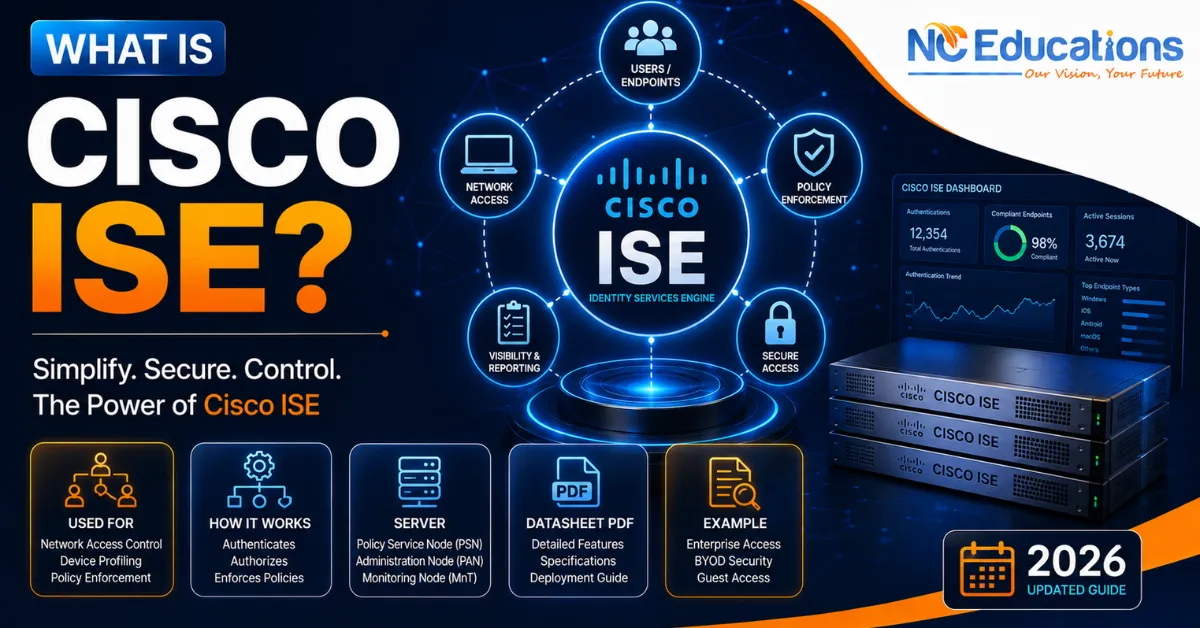
What is Cisco ISE?: Cisco ISE is a networking security policy management platform used that act as a central brain for network access control. Every device that connects to a network wether a laptop, a phone, a badge reader, a printer has to be identified and given the right level of access, and doing that manually at any real scale simply doesn’t work. That’s the exact problem Cisco ISE 300-715 was built to solve.
If you’ve read our guides on Cisco SD-WAN and Cisco ACI, ISE completes the picture: where SD-WAN connects sites, and ACI automates the data centre fabric, ISE decides who and what is allowed onto the network in the first place, and what they can touch once they’re on it. This guide explains what Cisco ISE actually does, how it fits into a zero-trust architecture, and where it sits in a security-focused Cisco career path.
What Is Cisco ISE?
Cisco Identity Services Engine (ISE) is advance networking certification exams known as ” 300-715 SISE” for networking professionals. It is a network secuirty platform taht sits aty the the centre of a network to rpovide security to wired, wireless, 5G and VPN connections. It has zero-trust architecture as the policy decision point in which the system that discovers, profiles, authenticates, and authorises every user, device, and endpoint trying to connect to the network.
Cisco ISE 300-715 teaches learners how to implement, configure, and manage centralized identity and access control using the this platform. The certification exams test how much knowledge and skills you have possed of this topic. Earning Cisco Identity Services Engine certification authenticates that you have knolwdge and hand on lab experience to manage a secuirty of network symstem using this platform.
Cisco ISE 300-715 Certification Exam Details
| Category | Details |
| Official Exam Name |
Implementing and Configuring Cisco Identity Services Engine (SISE)
|
| Exam Code | 300-715 |
| Exam Cost/Fee |
$300 USD (plus local taxes, where applicable)
|
| Cisco ISE 300 715 cost in India |
₹25,000 to ₹26,000 + 18% GST
|
| Exam Duration | 90 minutes |
| Number of Questions | 55-65 questions |
| Question Types |
Multiple Choice, Drag-and-Drop, and Performance-Based tasks
|
| Exam Language | English |
| Validity Period | 3 years |
| Earned Credentials |
• Cisco Certified Specialist – Security Identity Management
• Concentration credit towards CCNP Security |
Why Cisco ISE 300-715 Exists?
Every modern networks have to support a mix of corporate laptops, personal devices (BYOD), guests, contractors, and a growing number of IoT and OT devices that can’t run traditional security agents at all, printers, cameras, medical equipment, building automation systems. Manually managing access for that mix, device by device, doesn’t scale and leaves gaps.
Cisco ISE automates that entire process: it discovers what’s connecting, works out what kind of device it is, applies the right access policy automatically, and can act immediately if something looks wrong – without waiting for a human to notice.
What is Cisco ISE Used For?
It is software and a security platform in Cisco’s networking solutions. It is used to control and management access control to enterprise network.
The key main uses of Cisco ISE are:
- User and Device Authentication: It verifies the identity of users and devices before allowing them to connect to the network.
- Network Access Control: It controls network access based on the identity, role, and security status of users and devices.
- Device Profiling: It identifies and categorizes connected devices, such as laptops, smartphones, printers, IP phones, and IoT devices.
- Guest Access: It provides secure and controlled network access to visitors and temporary users.
- Posture Assessment: It checks whether connected devices meet defined security requirements before granting network access.
- Policy Management: It allows administrators to create and manage network access policies from a central platform.
- Network Visibility: It provides visibility into connected users, devices, and their network access activities.
How Cisco ISE Actually Works?
ISE’s job breaks down into four core stages, and understanding this sequence is the fastest way to actually get what it does:
- Discover: The ISE detects a new user or device attempting to connect to the network.
- Profile: IT uses passive network telemetry and predefined device templates then identifies what the device actually is (a Windows laptop, an IP phone, an IoT sensor) based on attributes like MAC address, DHCP data, and other network signals.
- Authenticate: ISE verifies identity using standard protocols – primarily RADIUS for network access and TACACS+ for device administration – supporting 802.1X, certificate-based authentication, and integration with identity sources like Active Directory and Entra ID.
- Authorise and enforce: Based on who and what the device is, ISE applies the appropriate access policy: full network access, restricted access, guest-only access, or quarantine – and it can act on this continuously throughout the session, not just at initial login.
Core Building Blocks of Cisco ISE
| Component | What It Does |
| Policy engine | The central decision-making system that evaluates identity, device posture, and context to determine access |
| Profiling | Automatically discovers, classifies, and identifies endpoints using passive monitoring and device templates |
| Posture assessment | Checks whether a connecting device meets security requirements – OS patches, antivirus status, disk encryption – before granting access |
| TrustSec / Security Group Tags (SGTs) | Lets organisations segment the network based on business roles rather than IP addresses, dramatically simplifying firewall and access rule management |
| Guest lifecycle management | Provides customizable guest portals for hotspot, self-service, or sponsored access with full auditing |
| pxGrid (Platform Exchange Grid) | Shares identity and device context with Cisco and third-party security tools, enabling coordinated threat response across the security stack |
ISE Deployment Options
ISE is available as a physical or virtual appliance, and Cisco supports virtual deployment across a wide range of platforms – VMware ESXi, Microsoft Hyper-V, Nutanix AHV, Red Hat OpenShift, and cloud environments including AWS and Azure. Both physical and virtual deployments can be clustered for the scale, redundancy, and failover an enterprise network needs, and new installations include a 90-day evaluation license for up to 100 endpoints so teams can test before committing.
Cisco ISE vs. Cisco ACI vs. Cisco SD-WAN
If you’ve been following this series, here’s how the three pieces fit together:
| Criteria | Cisco SD-WAN | Cisco ACI | Cisco ISE |
| What it governs | Connectivity between sites (WAN) | The data centre network fabric |
Who and what gets network access, everywhere
|
| Core question it answers | “How does traffic get from A to B efficiently?” | “How is the data centre network automated and secured?” |
“Should this user or device be allowed on, and what can it touch?”
|
| Where it operates | Branches, data centres, cloud edge | Inside the data centre |
Wired, wireless, VPN, and 5G – network-wide
|
ISE is genuinely the odd one out in terms of scope – it’s not tied to a single part of the network the way SD-WAN (WAN) or ACI (data centre) are. It’s the identity and policy layer that can apply across all of it.
Cisco ISE / Network Security Engineer Salary in India
Salary data specific to “Cisco ISE Engineer” as a standalone title is limited in the Indian market, since ISE expertise is usually one specialisation within a broader network security role rather than a distinct job title. Here’s what’s available, with sample sizes noted where possible.
| Source | What It Covers | Reported Figures |
| PayScale (Network Security Engineer, Cisco Networking skills, India) | Broader network security role with Cisco skills | Average base ₹7 lakh/year; range roughly ₹2–20 lakh/year depending on experience |
| 6figr.com (Cisco Engineer – Networking, India) | 182 salaries, broader networking title, not ISE-specific | Average ₹33 lakh/year; 70% of salaries fall between ₹22–97 lakh/year |
| ZipRecruiter (Cisco ISE Engineer, US) | US-specific, not India | Average $124,000/year ($106,000 base), useful mainly as a directional comparison, not an India benchmark |
The clearest signal here is that ISE rarely appears as an isolated job title – it’s almost always bundled into a broader network or security engineering role, and third-party industry commentary consistently points to CCIE Security-level certification, not ISE knowledge alone, as the real driver of top-end compensation in this space. Treat all figures above as directional and verify current numbers on Glassdoor or AmbitionBox before making a career decision based on salary.
Why Leanr Cisco ISE From NC Educations?
ISE is one of those platforms where the policy logic only really makes sense once you’ve configured an authentication policy yourself and watched a real device get profiled, authenticated, and dropped into the wrong VLAN because a rule was slightly off. That kind of troubleshooting instinct doesn’t come from reading a features list.
At NC Educations, CCNP Security and CCIE Security training treats ISE the same way – as a hands-on skill built through real policy configuration, real authentication flows, and real troubleshooting scenarios, guided by people who’ve actually deployed it in production networks. If you’re coming from a general networking background and want identity and access control to become a genuine specialisation, that structured, lab-first approach is what actually makes it stick.
Common Questions About Cisco ISE 300-715
Question: Is Cisco ISE hardware or software?
Answer: Cisco Identity Services Engine (ISE) is a software for networking solution. However it can run on hardware devices, virtually or in cloud environment.
Question: Is Cisco ISE a NAC?
Answer: Yes, Cisco ISE is a NAC (Network Access Control) solution.
Question: Is Cisco ISE the same as a firewall?
Answer: No. A firewall controls traffic based on network rules (IP addresses, ports, protocols). ISE controls whether a user or device gets onto the network in the first place, and what access level it receives based on identity and context.
Question: What’s the difference between Cisco ISE and Cisco ACI?
Answer: ISE handles identity-based access control across the whole network while ACI automates and secures the data centre network fabric specifically. They can work together, but they solve different problems.
Question: Does Cisco ISE require an agent on every device?
Answer: Not necessarily. ISE supports agent-based posture checking through Cisco Secure Client, but it also supports agentless and temporal options, and can profile many devices – including IoT devices that can’t run an agent at all – using passive network telemetry.
Question: Is Cisco ISE part of CCNP Security or CCIE Security?
Answer: Yes. ISE is a core topic in Cisco’s security certification track, since identity-based access control and zero-trust architecture are central to how Cisco frames modern network security.
Question: What is TrustSec in Cisco ISE?
Answer: TrustSec is Cisco’s software-defined segmentation technology, which uses Security Group Tags (SGTs) to control access based on business roles rather than IP addresses – simplifying firewall and access rule management significantly.
Also Read
14 thoughts on “What is Cisco ISE?: Used For, How it Work, Server, Datasheet PDF, Example 2026”