
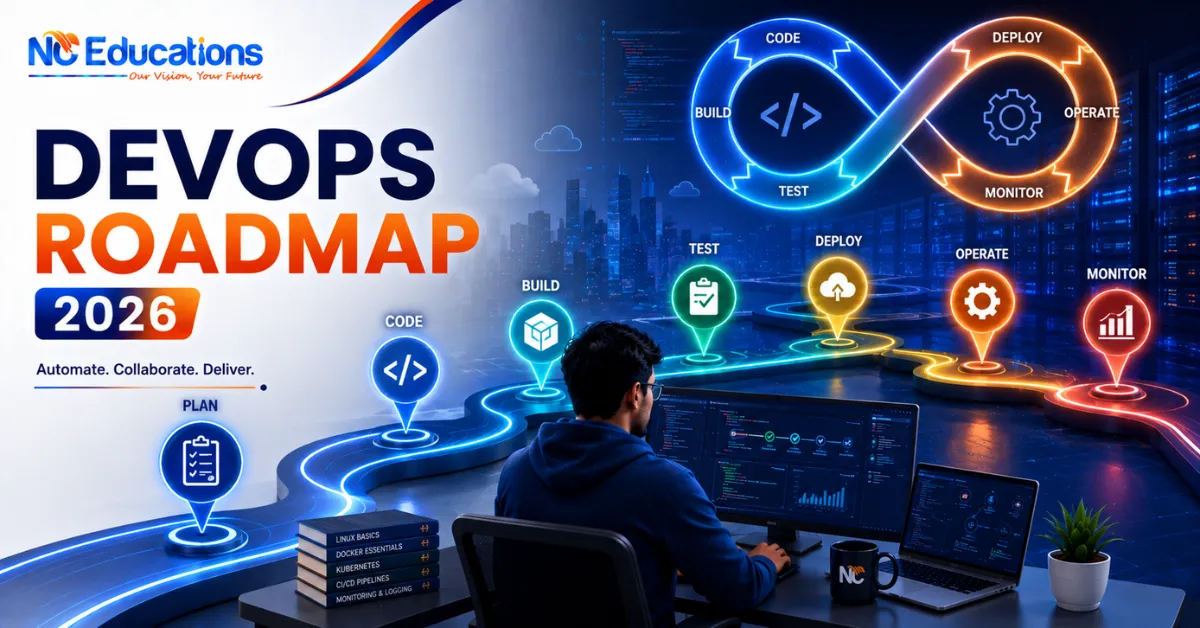
DevOps Roadmap 2026: DevOps is becoming a popular career choice in the Indian IT industry. As companies are adopting cloud and automation this increase the demand for skilled DevOps professionals too. However, starting a DevOps career in 2026 can feel confusing. There are so many AI tools, free learning resources, and technologies which is not fill for all. Knowing where to start and what to learn next is not easy for everyone, specially freshers.
We NC Educations created this DevOps Roadmap 2026 to provide you a simple learning path. You’ll start with Linux and basic IT concepts, then move on to tools like Git, Jenkins, Docker, Kubernetes, Ansible, and cloud platforms. You’ll also learn important areas such as CI/CD, automation, deployment, and monitoring.
This roadmap will help you to become a successful devops engineer no matter whether you’re a fresher, system administrator, IT professional, or developer planning to move into this. This career path guide will help you understand the skills you need and the right order to learn them to get highest salaries.
DevOps Roadmap 2026
The DevOps Roadmap 2026 follows a simple step-by-step order. Start with Linux, scripting, and Git, then move to CI/CD, Docker, Kubernetes, cloud, automation, and monitoring.
You don’t need to learn everything at once. Build your basics first, practice with real tools, and then move towards advanced DevOps skills and certifications.
This roadmap is useful for freshers as well as professionals from development, system administration, or QA who want to move into DevOps.
1. Foundation: Build Strong Fundamentals of a DevOps Engineer
Every DevOps engineer needs a solid base in system administration and scripting before touching any automation tool. Skipping this stage makes everything after it harder to understand.
- Operating Systems: Linux fundamentals, process & services, users & permissions, package management
- Networking Basics: TCP/IP, DNS, DHCP, ports & protocols, load balancing, firewalls
- Command Line: Bash basics, shell scripting, CLI tools, text processing
- Version Control: Git basics, branching & merging, pull requests, GitHub/GitLab
- Programming Basics (Scripting): Python/Bash, variables, loops, functions
This foundation gives you the strong IT base needed to work with tools and automate processes later.
2. Learn Core DevOps Concepts
Once your fundamentals are in place, it’s time to understand the philosophy and principles that DevOps is actually built around – because DevOps is as much a mindset as it is a set of tools.
- DevOps Culture & Mindset: Collaboration, communication, shared responsibility between dev and ops teams
- Agile Basics: Iterative development, Scrum/Kanban, continuous feedback loops
- CI/CD Concepts: Continuous integration, continuous delivery, continuous deployment
- Infrastructure as Code (IaC) Basics: Why IaC matters, declarative vs imperative approach, idempotency
- Monitoring & Logging Concepts: Metrics, logs, traces, observability, alerting
Understanding these concepts helps you see how DevOps actually improves software delivery and operations, not just how to run commands.
3. Essential Tools to Learn
These Concepts only make sense once you get your hands dirty with actual tools. This is the stage where most of your practical learning happens.
| Category | Tools / Technologies |
|---|---|
| OS & Scripting | Linux, Bash/Shell Scripting |
| Version Control | Git, GitHub, GitLab |
| CI Servers | Jenkins, GitHub Actions |
| Build Tools | Maven, Gradle |
| Artifact Repository | Nexus, JFrog Artifactory |
| Containerization | Docker |
| Orchestration | Kubernetes |
| Configuration Management | Ansible, Chef, Puppet |
Getting hands-on with these industry-standard tools is what actually makes you job-ready, far more than just reading about them.
4. Continuous Integration & Deployment
CI/CD is the heart of DevOps – it’s the automated pipeline that takes code from a developer’s laptop all the way to production without manual bottlenecks. Here’s how the flow typically works:
- Code Commit: Developer pushes code to the version control system
- Build: Code is compiled and packaged
- Unit Test: Automated tests validate the code
- Code Quality Analysis: Static analysis checks for bugs and code smells
- Build Artifact: A deployable package is created
- Deploy to Staging: The build is pushed to a test environment
- Testing: Further testing happens in staging
- Deploy to Production: The verified build goes live
- Monitor: The application is tracked for performance and errors post-deployment
Once you understand this flow, you can automate the entire software delivery lifecycle instead of doing repetitive manual releases.
5. Infrastructure as Code & Cloud
Modern DevOps engineers are expected to provision, manage, and secure infrastructure entirely through code rather than manually clicking around a console.
| Key Area | What It Covers |
| Infrastructure as Code | Terraform, CloudFormation |
| Cloud Platforms | AWS, Microsoft Azure, Google Cloud |
| Compute & Storage | EC2/VM, S3/Blob Storage |
| Networking | VPC/VNets, subnets, security groups/NSG, load balancers |
| Security Basics | IAM, security groups, secrets management |
Learning these areas well means you can provision, manage, and secure infrastructure in the cloud confidently – a core expectation in almost every DevOps job today.
6. Monitoring & Observability
Deploying code fast is only half the job – you also need to know when something breaks and why. This is where monitoring and observability come in.
Monitoring Tools
- Prometheus
- Grafana
Logging
- ELK Stack (Elasticsearch, Logstash, Kibana)
Alerting
- Alertmanager
- PagerDuty
APM/Tracing
- Jaeger
- Zipkin
Cloud Monitoring
- CloudWatch (AWS)
- Azure Monitor
- Stackdriver (GCP)
Getting comfortable with these tools lets you proactively monitor systems and resolve issues quickly, before they turn into bigger outages.
7. Advanced Topics for Devops Engineering
Once the core skills are solid, you can move into advanced areas that senior DevOps engineers and platform engineers are expected to know.
- Microservices, APIs & Service Mesh: Understanding how to design, connect, and secure microservices, along with tools like Istio for managing service-to-service communication at scale.
- GitOps & Container Security: Using tools like Argo CD to manage deployments through Git as the single source of truth, along with container security tools like Trivy and Aqua to catch vulnerabilities early.
- Cost Optimization & High Availability: Learning FinOps practices to control cloud spending, along with designing systems for high availability and disaster recovery so applications stay up even during failures.
8. Recommended Certifications For Devops Engineering Roadmap
Certifications aren’t mandatory, but they validate your skills and give recruiters confidence in your practical knowledge. Here’s what to aim for:
- AWS DevOps Engineer: Professional: Validates your ability to automate testing and deployment on AWS, one of the most recognised cloud certifications in India.
- Azure DevOps Engineer: Expert: Ideal if you’re working with Microsoft-based environments, covering CI/CD, infrastructure, and monitoring on Azure.
- Google Cloud DevOps Engineer: Professional: Focuses on reliability engineering practices and automation on GCP, useful for companies using Google Cloud.
- CKA: Certified Kubernetes Administrator: A strong proof of your Kubernetes skills, which is almost mandatory for mid to senior DevOps roles today.
- HashiCorp Terraform Associate: Validates your Infrastructure as Code skills, especially valuable since Terraform is used across multi-cloud environments.
How NC Educations Helps in Your DevOps Engineering Path?
Learning DevOps from random blogs and videos can be confusing. You may learn Docker from one place, Kubernetes from another, and CI/CD from somewhere else, but still not know how everything works together.
NC Educations brings everything together in one structured learning path. We help you start with Linux and scripting basics and gradually move towards Git, Jenkins, Docker, Kubernetes, Ansible, and cloud technologies.
Our hands-on training, practical projects, and real-world examples help you understand how DevOps tools are actually used in companies. Instead of only learning theory, you get opportunities to work on practical tasks and build your confidence step by step.
With guidance from experienced trainers and a curriculum focused on practical skills, NC Educations helps you move from learning DevOps to becoming job-ready for DevOps roles.
FAQs DevOps Engineer Roadmap 2026
Q1. What are the steps to becoming a DevOps engineer?
Ans. The steps to become a DevOps engineer includes learning Learn Linux, networking, and scripting. Then move to Git, CI/CD tools like Jenkins, Docker, and Kubernetes. After that, pick up Terraform, a cloud platform, and monitoring tools, and build real projects along the way.
Q2. What qualifications do you need to be a DevOps engineer?
Ans. There is no fixed qualification to be a DevOps engineer, however professionals with a B.Tech/B.E/MCA/BCA/ or technical degree are preferred by recuiters. The main factors are skills, practice, experience and certificate.
Q3. Is DevOps a dead-end job?
Ans. No, DevOps is one of the fastest-growing IT career tracks, with a clear growth path from Junior Engineer to DevOps Architect and even Engineering Manager.
Q4. What are the 7 phases of DevOps?
Ans. The 7 phases of a DevOps lifecycle are:
- Plan
- Code
- Build
- Test
- Release
- Deploy
- Operate/Monitor
3 thoughts on “DevOps Roadmap 2026: For Beginners, Github, Azure, AWS, Path PDF Free Download”