
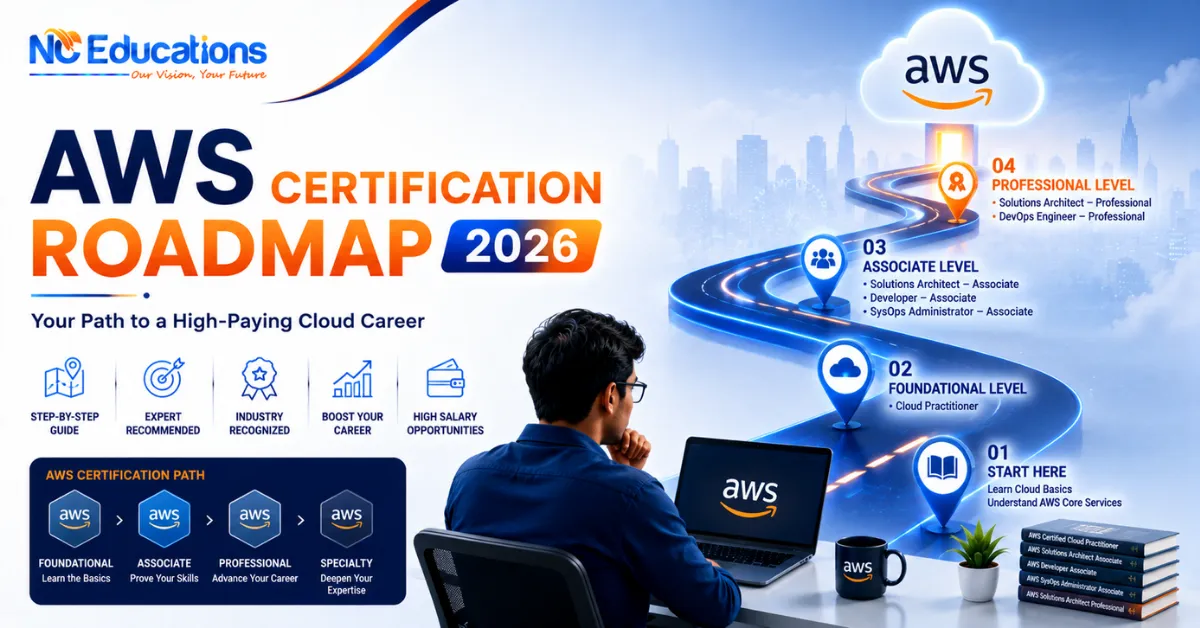
AWS Certification Roadmap 2026: An AWS certification roadmap gives you a clear order to follow instead of randomly picking exams based on what’s trending. AWS currently offers certifications across four levels – foundational, associate, professional, and speciality – and jumping into the wrong one first is one of the most common mistakes beginners make.
This article walks you through the entire path step by step: starting with the fundamentals you need before attempting any exam, choosing the right associate-level certification based on your career direction, moving up to the tougher professional exams, and finally picking a speciality if you want to stand out in a crowded job market. By the end, you’ll know exactly which certification to target first and why.
AWS Certification Roadmap 2026
The AWS certification roadmap for 2026 still follows the same four-tier structure AWS has used for years, but the exam content keeps getting updated to match what’s actually used in the industry – things like serverless architecture, cost optimization, and AI-integrated services are getting more weight now. Most beginners start with the AWS Certified Cloud Practitioner to get familiar with core concepts, then move into an associate-level exam that matches their career goal, whether that’s architecture, development, or operations. From there, professional certifications and speciality exams help you go deeper into a specific area once you have real hands-on experience to back it up.
1. Learning the Fundamentals of AWS
Before attempting any AWS certification, you need a working understanding of the basics. Get comfortable with core AWS services like EC2, S3, and IAM, along with general cloud concepts like regions, availability zones, and pricing models. Basic networking knowledge helps a lot here too, since concepts like VPCs and security groups come up constantly.
Most people start with the AWS Certified Cloud Practitioner exam at this stage, since it covers these fundamentals without expecting great technical hands-on skills yet. Skipping this stage and jumping straight into associate-level prep usually backfires when the exam questions get more scenario-based.
2. Choosing an AWS Certification Path
Once the fundamentals are sorted, you’ll need to pick an associate-level certification that matches where you want your career to go. Each path focuses on a different day-to-day role, so it’s worth thinking about whether you enjoy designing systems, writing code, managing operations, or working with data before choosing. Here’s a quick overview of the four options:
| Certification | Best Suited For |
| AWS Certified Solutions Architect – Associate | Those who enjoy designing scalable, cost-efficient cloud systems |
| AWS Certified Developer – Associate | Developers who build and deploy applications on AWS |
| AWS Certified SysOps Administrator – Associate | Engineers focused on operations, monitoring, and troubleshooting |
| AWS Certified Data Engineer – Associate | Those interested in data pipelines, storage, and analytics workflows |
3. AWS Certified Solutions Architect
This is the most popular associate-level certification, and for good reason – it’s broad enough to open doors across multiple roles. It tests your ability to design distributed systems that are secure, cost-effective, and resilient to failure. You’ll need to understand how different AWS services fit together, from compute and storage to networking and databases.
This certification works well if you’re not entirely sure which specific direction you want to take yet, since architecture knowledge is useful no matter which cloud role you eventually land in.
4. AWS Certified Developer
If you come from a coding background or plan to work closely with application deployment, this certification fits better than the architect path. It focuses on developing and maintaining applications on AWS, covering topics like Lambda functions, API Gateway, DynamoDB, and CI/CD pipelines.
The exam expects you to understand how to write code that interacts efficiently with AWS services, along with debugging and optimising application performance. It’s a solid pick for software developers who want to move into cloud-native development roles.
5. AWS Certified SysOps Administrator
This certification leans heavily into operations – deploying, managing, and monitoring systems on AWS. It’s considered one of the tougher associate-level exams because it expects hands-on familiarity rather than just theoretical knowledge. You’ll be tested on monitoring tools, automation, backup strategies, and troubleshooting real infrastructure issues.
If your interest lies in keeping systems running smoothly rather than designing them from scratch, this path suits people aiming for cloud operations or infrastructure support roles.
6. AWS Certified Data Engineer
This is one of AWS’s newer associate certifications, built for people who want to work with data pipelines and analytics on the cloud. It covers services like Glue, Redshift, Kinesis, and data lake architectures, along with how to design efficient, secure data workflows.
Given how much companies are investing in data and AI right now, this certification has been gaining popularity fast. It’s a good fit if you’re more interested in handling large datasets than general infrastructure work.
7. Advance to professional level
Once you’ve cleared an associate certification and have some real project experience under your belt, the professional-level exams are the natural next step. These are significantly harder, expect deep hands-on expertise, and are respected by employers precisely because they’re not easy to clear. AWS currently offers two professional certifications, each building on a different associate path:
| Certification | Focus Area |
| AWS Certified Solutions Architect – Professional | Advanced architecture design, migration strategies, and multi-account governance |
| AWS Certified DevOps Engineer – Professional | Automating deployment, monitoring, and infrastructure management at scale |
8. Choose a speciality to stand out
Speciality certifications aren’t compulsory, but they’re a great way to signal deep expertise in a specific niche once you’ve built a strong foundation. These are usually pursued by engineers who already know which direction they want to specialise in.
| Specialty Certification | Focus Area |
| AWS Certified Security – Speciality | Cloud security practices, encryption, and compliance |
| AWS Certified Advanced Networking – Speciality | Complex networking architectures on AWS |
| AWS Certified Machine Learning – Speciality | Building and deploying ML models using AWS services |
| AWS Certified Database – Speciality | Designing and managing AWS database solutions |
How NC Educations Helps in Your AWS Certification Path?
Preparing for AWS certifications alone can get overwhelming, especially with how frequently exam content gets updated. NC Educations gives you structured below facilties:
- A mentor-led training built around the actual current exam pattern, so you’re not studying outdated material.
- You get access to hands-on labs, real AWS environments to practice in, and trainers who’ve worked with these services in live projects, not just theoretical classrooms.
- Add in doubt-clearing sessions, mock exams, and placement support, and you have a much clearer, faster path to getting certified compared to figuring it all out through scattered YouTube playlists on your own.
FAQs Related to AWS Certification Roadmap 2026
Question: In which order should I take AWS certifications?
Answer: Start with the Cloud Practitioner, move to an associate-level certification matching your career goal, then professional-level exams, and speciality certifications last.
Question: Can I learn AWS in 3 months?
Answer: Yes, with consistent daily practice, you can cover the fundamentals and clear an associate-level exam in around three months.
Question: What is the roadmap to learn AWS?
Answer: Begin with cloud basics and the Cloud Practitioner exam, then pick an associate path like Solutions Architect or Developer, followed by hands-on projects.
Question: What is the AWS job salary?
Answer: AWS-certified professionals in India generally earn competitive salaries that scale with experience, with certified engineers often earning noticeably more than non-certified peers in similar roles.
Related Articles
4 thoughts on “AWS Certification Roadmap 2026: Path Diagram, For Developers, For Beginners, For Data Engineering, Highest Earning Guide PDF”