
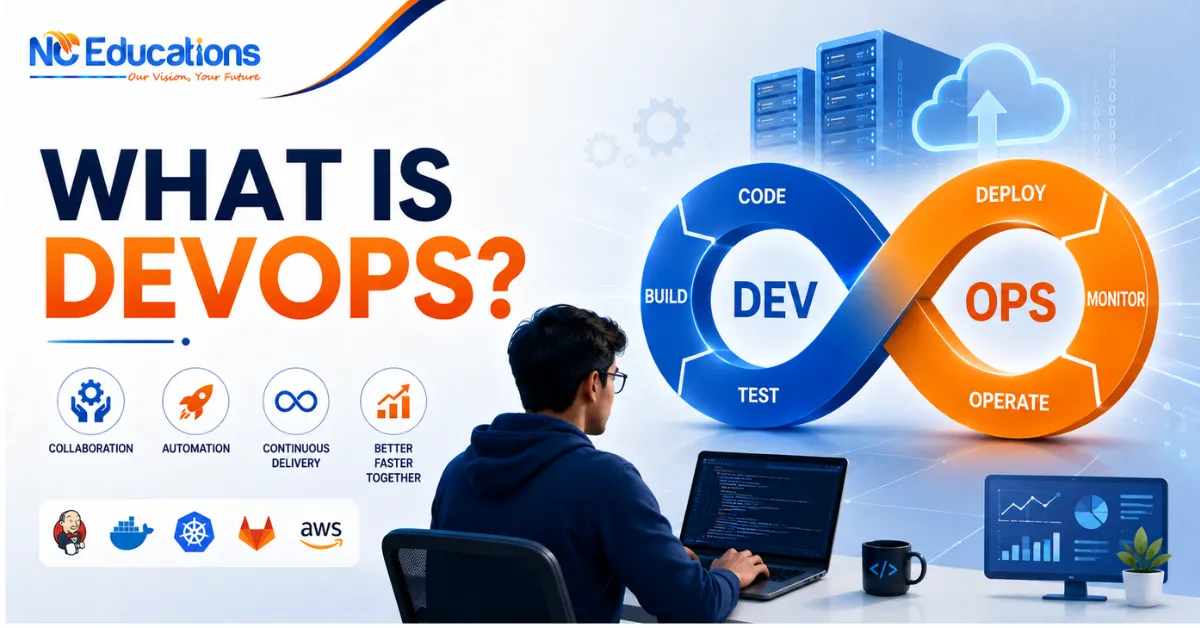
In simple words, DevOps is a way for software developers and IT operations teams to work together to build, test, and release software faster and more reliably. If you have spent even ten minutes scrolling through IT job portals lately, you have probably noticed this word popping up everywhere. Companies from startups to giants like Amazon, TCS, and Infosys are hiring DevOps engineers on a war footing, and salaries for this role are among the highest in the software industry right now.
But here’s the confusing part: ask five people “what is DevOps?“, and you’ll get five different answers. Some call it a job role, others call it a set of tools, and some just say “it’s coding plus operations.” So which one is right?
What is DevOps?
DevOps is a combination of two words Development and Operations. In simple terms, it is a culture and a set of practices that bring software developers and IT operations teams together, instead of letting them work in separate silos as they used to years ago.
Earlier, developers would write code and simply hand it over to the operations team to deploy and manage. If something broke, both teams would blame each other, and fixing bugs took days or even weeks. DevOps changes this by making both teams work as one unit, right from planning and coding to testing, deployment, and monitoring.
At its core, DevOps is about speed and reliability. It uses automation, continuous integration, and continuous delivery (commonly shortened to CI/CD) so that new features and updates reach users faster, with fewer errors. So when someone asks what DevOps in software engineering is, the short answer is: it’s the practice of automating and streamlining the entire software delivery process so that teams can build, test, and release software quickly and safely.
This is also why DevOps is not really “full of coding” in the traditional sense – it involves scripting and automation, but it leans more towards process, tools, and collaboration than writing large applications from scratch.
Example of DevOps
Think of an e-commerce app like Flipkart during a big sale. Every day, developers push small updates like a new offer banner, a bug fix, a faster checkout page. Without DevOps, each update would need manual testing and manual server deployment, which could take hours and risk crashing the app during peak traffic.
With DevOps, the moment a developer commits new code, automated tools test it, package it, and deploy it to live servers within minutes – often without any human touching the servers directly. If something goes wrong, monitoring tools alert the team instantly, and the system can even roll back automatically. That’s DevOps working quietly in the background.
How DevOps Works?
DevOps works in a loop, often shown as an infinite symbol, because it never really “ends” – it keeps repeating with every new release. It generally follows these stages: planning the work, coding the feature, building it, testing it automatically, releasing it, deploying it to servers, operating it in the live environment, and monitoring it for issues. Feedback from monitoring then flows back into planning, and the cycle starts again.
This is often called the DevOps life cycle, and the entire idea is to shrink the time between writing code and getting it safely in front of real users. To make this loop fast and consistent, DevOps engineers rely heavily on automation tools – for version control, building code, testing, deploying, and tracking infrastructure. Popular DevOps tools include Git, Jenkins, Docker, Kubernetes, Ansible, and cloud platforms like AWS and Azure. Instead of manually doing repetitive tasks, engineers write scripts and configurations so machines handle the heavy lifting, and humans focus on improving the process.
DevOps Engineer Course Syllabus
Most good DevOps courses in India are structured to take you from the basics of Linux and networking all the way to real cloud deployments. A typical syllabus usually covers:
- Linux fundamentals and shell scripting
- Version control with Git and GitHub
- Continuous Integration and Continuous Delivery (CI/CD) using tools like Jenkins
- Containerization with Docker
- Container orchestration using Kubernetes
- Configuration management tools such as Ansible or Puppet
- Infrastructure as Code (IaC) using Terraform
- Cloud computing basics on AWS or Azure
- Monitoring and logging tools like Prometheus, Grafana, and Nagios
- Real-world capstone projects to build a portfolio
A well-designed course does not just teach tools in isolation – it shows you how they connect to form the DevOps pipeline, since that’s exactly what interviewers test you on.
Who DevOps Engineer Course Is For?
Not everything is for everyone like that a DevOps career path is also not for everyone. Below we have mentioned some of the students profile whom studying this course would be best and whome for those this could mean waste of time. It will helps you to know where you stand before enrolling.
It is a good Course if:
- You have some basic understanding of Linux, networking, or programming (even beginner level is fine).
- You enjoy working with systems, automation, and problem-solving rather than pure UI-based coding.
- You are currently a software developer, system admin, or fresher wanting to enter cloud and infrastructure roles.
- You are comfortable learning multiple tools together, since DevOps is tool-heavy.
You Might struggle if:
- You don’t have any knowledge of coading at all. Or you have zero exposure to any programming or command-line work and expect a very slow, code-free start.
- You are looking for a purely theoretical course without hands-on labs.
- You are expecting to master DevOps in a week or two. It genuinely takes consistent practice over months.
- You don’t like working with servers, cloud consoles, and terminal-based tasks.
If you fall in the second list, it doesn’t mean DevOps is out of reach – it just means you may need a short prep phase in Linux and Git basics before diving in.
Common Mistakes While Learning DevOps Course
A lot of students jump into DevOps courses with the wrong expectations, and it costs them time later. Here are mistakes to avoid:
- Skipping the Linux and networking basics. Many learners rush straight to Docker and Kubernetes without understanding how servers, ports, and processes actually work, and end up lost halfway through the course.
- Treating it as a “coding course.” DevOps involves scripting, but students expecting a heavy programming curriculum like a software development course often get confused about what they signed up for.
- Not practising on real cloud accounts. Watching videos about AWS or Docker is not the same as actually creating instances, breaking things, and fixing them yourself. Hands-on practice is non-negotiable in DevOps.
- Ignoring interview preparation. DevOps interview questions often test practical troubleshooting, not just tool definitions. Students who only memorise theory struggle when asked scenario-based questions.
- Comparing salary expectations without building skills first. Everyone hears about the high DevOps engineer salary and jumps in for the money, but without solid hands-on projects, cracking that first job becomes difficult.
What After a DevOps Course?
Once you complete a DevOps course, you don’t just stop there – the field keeps evolving, and many professionals go on to specialise further. Some popular next steps include:
- Cloud certification courses like AWS Certified DevOps Engineer, Azure DevOps Engineer Expert, or Google Cloud Professional DevOps Engineer
- Kubernetes specialisation through certifications like CKA (Certified Kubernetes Administrator)
- Site Reliability Engineering (SRE) courses, which build on DevOps concepts with a stronger focus on system reliability
- Cybersecurity and DevSecOps courses, since security is increasingly built into the DevOps pipeline
- Advanced scripting courses in Python or Go for deeper automation skills
These additional certifications help you stand out in interviews and often lead to senior or specialised roles with better pay.
Why Pursue a DevOps Course from NC Educations?
DevOps continues to be one of the most in-demand skills in India’s IT sector, with job postings and average salaries for DevOps engineers consistently ranking among the top in tech recruitment reports year after year. Cloud adoption across Indian companies is only accelerating, which means the demand for skilled DevOps professionals is expected to keep growing well into the next few years.
At NC Educations, the DevOps Engineer course is built keeping this real hiring landscape in mind. The training focuses on hands-on labs rather than just slides, so you actually work with Git, Docker, Kubernetes, Jenkins, and cloud platforms instead of just watching demonstrations. The curriculum is regularly updated to match what companies are actually asking for in interviews, and learners get guidance on building a project portfolio that recruiters can verify.
Beyond the technical training, NC Educations also supports learners with interview preparation and doubt-clearing sessions, which matters a lot when you’re trying to break into a competitive field like DevOps. Whether you’re a fresher trying to enter the IT industry or a working professional looking to upskill into cloud and automation roles, the course is structured to take you from the basics to job-readiness in a practical, step-by-step manner.
If you’re serious about building a career in DevOps, learning it the right way – with real tools, real projects, and real mentorship – makes all the difference between just knowing the theory and actually being job-ready.
FAQs About DevOps Engineering
Ques: Is DevOps full of coding?
Ans. Not really. DevOps does involve some scripting, mainly for automation like deployments, server setup, and monitoring. You don’t need to build big software applications.
Ques: What is DevOps salary?
Ans. The average salary for DevOps engineers in India is between INR 4.2 LPA to INR 20.8 LPA within the zero to 4 years experience range. Generally the pay well because there is high demand for skilled professionals. Salary depends on your experience, skills, city, and company. Freshers can get a good starting package, while experienced engineers with cloud and Kubernetes skills can earn much more.
Ques: What is the job role of DevOps?
Ans. A DevOps engineer manages things like CI/CD pipelines, cloud servers, deployments, monitoring, and fixing issues. Basically, they help developers and IT teams work together and make sure software is released smoothly without breaking things.
Ques: What are DevOps tools?
Ans. DevOps uses many different tools, and the common ones are Git and GitHub for code, Jenkins for CI/CD, Docker and Kubernetes for containers, Ansible for configuration, Terraform for infrastructure, and Prometheus and Grafana for monitoring. Cloud platforms like AWS, Azure, and Google Cloud are also widely used.
Related Posts
Hey i wanted to do a Devops Engineering but graduated with BCom degree. Is it possible for me?