
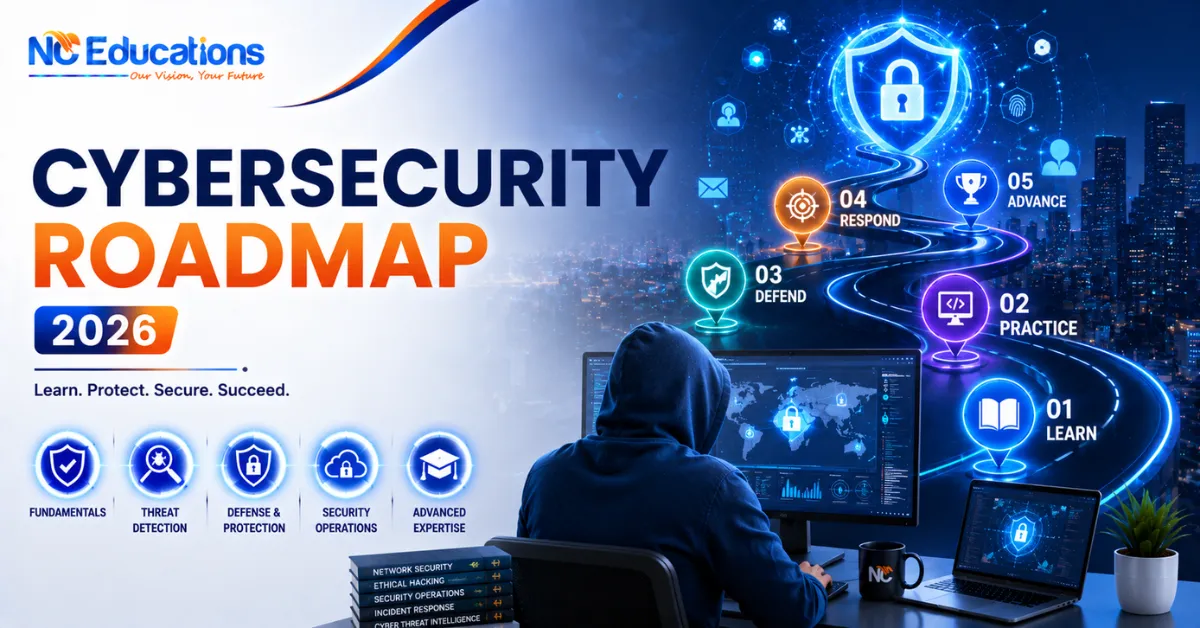
Cybersecurity Roadmap 2026: A cybersecurity roadmap gives you a clear, step-by-step path to start your career in cybersecurity instead of randomly jumping between YouTube videos, courses, and certification names you have heard about. Cybersecurity has many different roles, from SOC analysts and penetration testers to security engineers and compliance professionals, so trying to learn everything at once can quickly become confusing.
So we (NC Educations) created Cybersecurity Roadmap 2026 article. This takes you through the complete journey in the right order: building basic IT knowledge, learning important security concepts, getting familiar with the tools professionals use every day, choosing a certification path based on your career goals, and finally specialising in an area where you can build strong skills.
By the end, you’ll have a clear and practical cybersecurity roadmap to follow instead of a long, scattered list of things you need to learn “someday”.
Cybersecurity Roadmap 2026
The cybersecurity roadmap for 2026 follows the same basic path as before, but now there is more focus on cloud security, automation, and AI-based threat detection. Most beginners start with IT and networking basics, then move to security concepts like threats, access management, and security operations. After that, you can choose a path based on your interest, such as blue team and SOC roles, penetration testing, or GRC. Hands-on practice through labs and CTFs is just as important as certifications.
1. Start with Foundation & Fundamentals of Cybersecurity
Before touching anything security-specific, you need a solid IT base to build on. Here’s what to focus on first:
- Networking basics – TCP/IP, DNS, DHCP, and the OSI model
- Operating systems – getting comfortable with both Windows and Linux
- Security basics – understanding the CIA triad, common threats, and risk management
- Cryptography basics – encryption, hashing, and digital signatures
- Web and app basics – how websites and applications work, plus the OWASP Top 10
- IT fundamentals – hardware, virtualisation, and basic cloud concepts
- Command line – Linux CLI and PowerShell basics
2. Learn core cybersecurity concepts
Once your fundamentals are solid, it’s time to dive into the concepts that form the backbone of actual security work. These topics show up in every role, regardless of which specialisation you eventually pick:
- Threats and malware – types of malware, attack vectors, and basic malware analysis
- Network security – firewalls, IDS/IPS, VPNs, and secure protocols
- System security – hardening, patching, and access control based on least privilege
- Application security – secure coding practices and basic SAST/DAST concepts
- Identity and access management – IAM, MFA, SSO, and privileged access controls
- Security operations – logging, monitoring, SIEM basics, and alerting
- Risk and compliance – risk assessment along with standards like NIST and ISO 27001
3. Essential tools to learn
Knowing the concepts is only half the job – you also need to get comfortable with the tools professionals actually use on the ground. Here’s a breakdown of what to learn and why:
Wireshark
- A network protocol analyser used to capture and inspect network traffic
- Helps you understand how data actually moves across a network
- Essential for troubleshooting and spotting suspicious activity
Splunk / ELK Stack
- Used for log analysis and security monitoring
- Splunk is common in enterprise SOC environments
- ELK Stack (Elasticsearch, Logstash, Kibana) is a popular open-source alternative
Nessus
- A vulnerability assessment tool used to scan systems for known weaknesses
- Helps prioritise which vulnerabilities need fixing first
- Widely used in both offensive and defensive security roles
Kali Linux
- A Linux distribution built specifically for penetration testing
- Comes preloaded with tools for reconnaissance, exploitation, and reporting
- The go-to environment for anyone learning offensive security
Wazuh
- An open-source endpoint security and monitoring platform
- Used for threat detection, incident response, and compliance monitoring
- A good hands-on tool for building your own home SOC lab
AWS Security Tools
- Covers cloud-native security services within AWS environments
- Useful as more companies move their infrastructure to the cloud
- Important if you’re aiming for a cloud security specialisation later
4. Cybersecurity Certification Path
Choosing the right certification is depends on one’s personal need, career goals, interested and job profile aim. Therefor to get right certification create your requirements and choose one from the below list:
| Path | Certification Progression |
| Beginner | CompTIA Security+ → TryHackMe/Hack The Box (hands-on) → CompTIA CySA+ → CompTIA PenTest+ → (ISC)² SSCP or CISSP |
| Blue Team (SOC Analyst) | CompTIA Security+ → Microsoft SC-900 → Microsoft SC-100 → Microsoft SC-200 → Microsoft SC-300 |
| Offensive Security (Pentester) | CompTIA Security+ → eJPT → OSCP → OSWE → OSEE/CREST |
| Governance, Risk & Compliance | CompTIA Security+ → CompTIA CySA+ → (ISC)² SSCP → CISM → CISSP |
5. Choose a Speciality To Stand Out
Once you’ve built a strong foundation, picking a speciality helps you go deeper and become genuinely valuable in a specific niche rather than a generalist. Here’s a quick overview of the major specialities:
| Specialization | Focus Area |
| SOC Analyst | Monitoring, threat detection, and incident response |
| Penetration Tester | Ethical hacking, exploitation, and red teaming |
| Incident Responder | Handling breaches, forensics, and digital investigation |
| Threat Intelligence | Threat hunting, IOCs, and tracking threat feeds |
| Cloud Security | Securing AWS, Azure, and GCP environments, including containers and IaC |
| Application Security | Secure SDLC, DevSecOps, and API security |
| GRC / Auditor | Policy, audit, risk, and compliance management |
Specialization areas
Here’s a closer look at what each specialisation actually involves day-to-day, so you can pick the one that genuinely interests you:
SOC Analyst
- Monitors security alerts and logs on an ongoing basis
- Handles initial threat detection and incident triage
- A common entry point into the cybersecurity field
Penetration Tester
- Simulates real attacks to find security weaknesses before attackers do
- Involves ethical hacking, exploitation, and reporting findings
- Often includes red team exercises against live systems
Incident Responder
- Steps in when a security breach actually happens
- Handles digital forensics and investigation work
- Requires calm, methodical thinking under pressure
Threat Intelligence
- Focuses on tracking emerging threats and attacker behaviour
- Works with indicators of compromise and threat feeds
- Helps organisations stay ahead of attacks rather than just reacting
Cloud Security
- Secures infrastructure across AWS, Azure, and GCP
- Covers container security and infrastructure-as-code practices
- A fast-growing area as more companies shift to the cloud
Application Security
- Focuses on securing software throughout the development lifecycle
- Involves DevSecOps practices and API security
- Suited for people who enjoy working closely with developers
GRC / Auditor
- Deals with policies, audits, and regulatory compliance
- Less hands-on technically, more focused on risk management
- A good fit for people who prefer structured, process-driven work
How NC Educations Helps You in Your Cybersecurity Path?
Figuring out “How to Become a Cybersecurity Engineer?” on your own could be confusing, time taken, and could go wrong (not as you expected). Finding right tools, study material, certifications, and specialisations out of so many. Thus NC Educations gives you structured career path to become a Cybersecurity Engineer and also below benefits:
- A expert mentor-led training that maps directly to this roadmap, so you’re not wasting time guessing what to learn next.
- You get hands-on lab access, real attack-and-defence scenarios to practice on, and guidance from trainers who’ve actually worked in security roles rather than just teaching theory.
- You will have recording of every class for revision, practice and in case you missed any class.
- You will have a doubt clearing sessions for Lab and classes.
- We will arrange mock interviews in our 100% placement assistance programme which includes resume building, linkedin connection building, reconmendation and more.
- A certification from NC educations that you have completed training for Cyber Security. Which give you credential if you don’t do any official certification or add additional support top of your any official certification.
- You get a much faster and clearer path into cybersecurity compared to piecing it together from scattered free resources online.
FAQs Related to Cybersecurity Engineer Roadmap
Question: How do I become a cybersecurity engineer?
Answer: Start with IT and networking fundamentals, learn core security concepts, get hands-on through labs and CTFs, and clear a beginner certification like CompTIA Security+.
Question: What qualifications do you need to be a cybersecurity engineer?
Answer: A degree in computer science or IT helps, but practical skills, certifications, and hands-on lab experience matter just as much, if not more, to employers.
Question: What are L1, L2, and L3 in cybersecurity?
Answer: L1 handles basic monitoring and initial alerts, L2 investigates more complex incidents, and L3 deals with advanced threats, deep investigations, and critical escalations.
Question: Is cybersecurity a 9-5 job?
Answer: It depends on the role – SOC and incident response roles often involve shifts or on-call work, while GRC and consulting roles tend to follow more regular hours.
Related Articles