
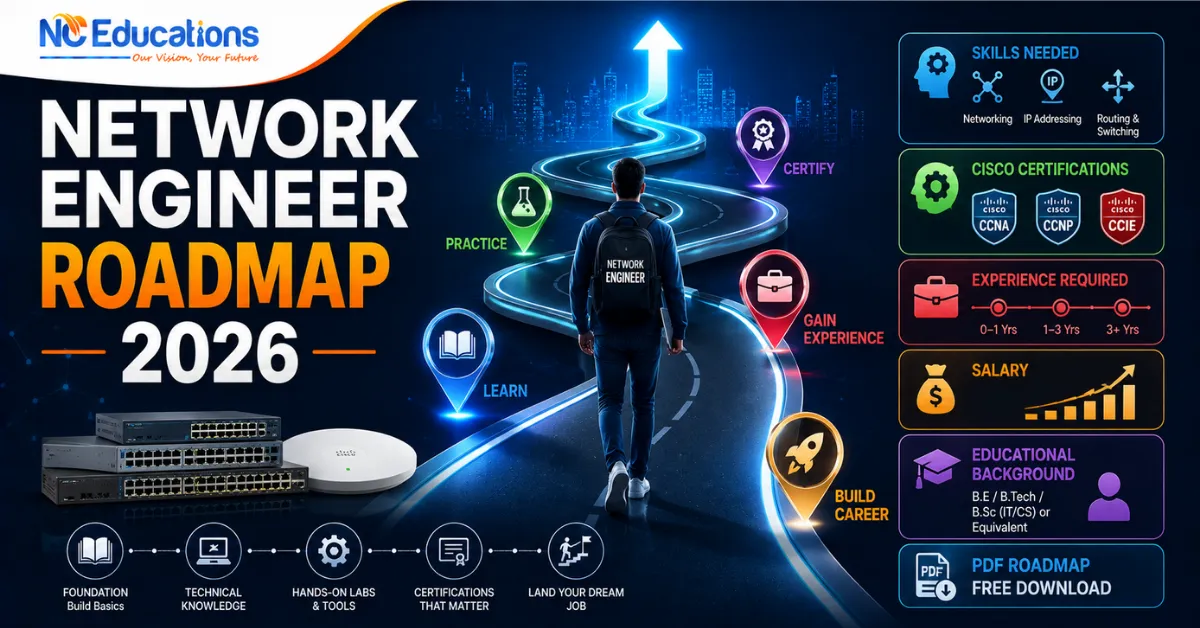
Thinking of becoming a Network Engineer in 2026? Or have doubts it is future proof, how things changed after AI? or how much can i earn, what are job roles or is it hard?. If this is you then don’t worry we have created a Networking Engineering roadmap specially for you to become a successful network engineering in 2026 and earn a good salary.
This roadmap follows seven stages, from networking basics to advance, then cisco certifications, advanced/additional skills needed, experience, educational background and more. Most beginners take 6-12 months to become netwrking job-ready with CCNA-level skills, and 2-4 years to reach a mid-to-senior network engineer role.
This guide breaks down every stage in detail, compares certifications, and shows you exactly how NC Educations structures its training to take you from a networking beginner to a hired, job-ready network engineer.
Network Engineer Roadmap 2026
This roadmap works whether you’re a fresher with zero IT background, a system administrator moving into networking, or an IT support engineer looking to specialise. You don’t need a computer science degree – you need a structured plan, consistent lab practice, and the right certifications at the right time. That’s exactly what this guide and the NC Educations training path are built around.
Step 1: Networking Basics
Every strong network engineer starts with the fundamentals. So this is your entry step in the network engineering field.
In this you will learn about:
- OSI and TCP/IP models: You will understand how data moves through seven (or four) layers, and why troubleshooting “starts at Layer 1”.
- IP addressing and subnetting: Learn about IPv4/IPv6 addressing, CIDR notation, VLSM, and subnet calculations (this is the single most tested practical skill in interviews).
- Ports and protocols: Difference between TCP vs UDP, well-known port numbers (80, 443, 22, 53, etc.).
- DNS: Learn about domain resolution, it works and record types (A, AAAA, CNAME, MX).
- DHCP: IP lease process (Discover, Offer, Request, Acknowledge)
- ARP: how IP addresses resolve to MAC addresses on a local network
Why it matters?: Recruiters and interviewers almost always test subnetting and OSI-layer troubleshooting first, this stage forms the vocabulary you’ll use for the rest of your career.
Step 2: Routing & Switching
This is the actual basic part of Network Engineer after fundamentals, in which you learn about managing networks of a enterprise. The key topics are:
- VLANs – logical network segmentation, VLAN tagging (802.1Q)
- STP (Spanning Tree Protocol) – loop prevention in switched networks
- Trunking – carrying multiple VLANs over a single link
- Static routing – manually defined paths for smaller networks
- OSPF – the most common interior gateway protocol used in enterprise routing
- BGP basics – the protocol that runs the internet and connects large networks/ISPs
This is where you start thinking like a network engineer instead of a network user, designing how traffic should flow, not just how to connect a device.
Step 3: Network Security
This is the mid level learning part of this roadmap career. Every modern network engineer roles blend directly into security. You don’t need to be a security specialist, but you do need working knowledge of:
- Firewalls – stateful inspection, zone-based policies, next-gen firewall concepts
- VPNs – site-to-site and remote-access VPNs, IPsec vs SSL
- NAT – static NAT, dynamic NAT, and PAT (port address translation)
- ACLs – standard and extended access control lists for traffic filtering
- Core security concepts – CIA triad, zero trust basics, and an introduction to ZTNA/SASE, which are increasingly replacing traditional VPN architectures in enterprise networks
Nowadats every employers now expect every network engineer to understand these basics well enough to build and defend secure network designs not just security teams.
Step 4: Hands-On Lab Practice
Theory alone won’t get you hired. You need to understand how networking actually works?, how to create network of a enterprise? In hand lab experinece of every segments because Employers filter candidates by practical, demonstrable skill.
- Cisco Packet Tracer – best for beginners; visual, free, ideal for CCNA-level practice
- GNS3 / EVE-NG – closer to real production environments; run actual Cisco, Juniper, or Fortinet images for CCNP-level and multi-vendor practice
- Home lab practice – build small topologies (VLANs, OSPF, ACLs, site-to-site VPN) repeatedly until configuration becomes second nature, not something you have to look up
- Documentation habit – start writing configs, diagrams, and troubleshooting notes now; this becomes a core job skill later
Tip: Recreate every topology you learn in a course at least three times from memory. Employers test configuration speed and troubleshooting logic far more than theory.
Step 5: Cisco Certifications
Certifications validate your skills to recruiters and applicant-tracking systems, and they give your self-study a clear structure.
| Certification | Level | Focus Area | Best For |
| CompTIA Network+ | Entry | Vendor-neutral networking fundamentals | Absolute beginners before CCNA |
| CCNA | Entry-Associate | Routing, switching, IP services, security basics | Your first serious networking certification |
| CCNP Enterprise (CCNP ENCOR + CCNP ENARSI) | Professional | Advanced routing/switching, WAN, automation | Mid-level engineers, 1-3 years’ experience |
| CCSA / Fortinet NSE | Specialist | Firewall administration (Check Point / FortiGate) | Engineers moving into network security |
| CCIE | Expert | Enterprise-scale design and troubleshooting | Senior/architect-level roles |
Step 6: Advanced Skills
This is what separates a mid-level network engineer from a senior one in 2026’s job market.
- Network automation – using Ansible, Terraform, or Nornir to configure devices at scale instead of manually, device by device
- Python for networking – scripting with libraries like Netmiko and NAPALM to parse configs, audit devices, and automate repetitive tasks
- SD-WAN – Cisco Viptela, Fortinet Secure SD-WAN, or similar platforms replacing traditional WAN architectures
- Cloud networking – AWS VPCs, Azure Virtual Networks, and GCP VPCs; understanding hybrid connectivity (Direct Connect, ExpressRoute, VPN gateways) is now close to mandatory, not optional
- Advanced troubleshooting – packet capture analysis (Wireshark), correlating multi-vendor logs, and diagnosing issues across on-prem and cloud simultaneously
Engineers who combine core networking with even basic automation and one cloud platform consistently qualify for higher-paying, more senior roles.
Step 7: Real-World Experience
Certifications and labs get you the interview. Real-world experience gets you promoted.
- Monitoring – working with tools like SolarWinds, PRTG, Zabbix, or Grafana to track network health
- Incident handling – following structured troubleshooting and escalation processes during outages
- Network changes – executing planned changes through proper change-management processes
- Documentation – maintaining network diagrams, IP address plans, and configuration backups
- Production troubleshooting – diagnosing live issues under time pressure, where lab conditions no longer apply
Look for internships, help-desk-to-network-team transitions, or NOC (Network Operations Centre) roles – these are the most common entry points into hands-on production experience.
Network Engineering Career Path & Salary Expectations
Network Engineer compensation varies significantly by region, certification level, and specialisation (cloud networking and security-focused engineers typically command a premium over generalist roles). Rather than relying on outdated averages, check current listings on sites like Glassdoor, Payscale, or LinkedIn Salary Insights filtered to your city and experience level for the most accurate figure.
| Experience Level | Typical Profile | Annual Salary Range (INR) |
| Fresher (0-1 yrs) | CCNA-certified, entry-level Network/NOC Support Engineer | ₹3 LPA – ₹6 LPA |
| Mid-Level (2-5 yrs) | CCNP-track or CCNP-certified, hands-on routing/switching/firewall experience | ₹7 LPA – ₹16 LPA |
| Senior / Highly Skilled (5+ yrs) | CCNP/CCIE with cloud networking, automation, or SD-WAN specialisation | ₹18 LPA – ₹35+ LPA |
A few things that consistently move you toward the top of each band:
- Certifications – CCNP typically adds 35-55% over a CCNA-only salary; CCIE and specialist certifications push further
- Cloud networking skills (AWS VPC, Azure VNet, GCP networking) – command a strong premium as hybrid infrastructure becomes standard
- Network automation (Python, Ansible, Netmiko, NAPALM) – among the highest salary multipliers in the field, since automation-capable engineers remain rare
- SD-WAN experience – increasingly valuable as enterprises phase out traditional MPLS
- City and company type – metro tech hubs (Bangalore, Hyderabad, Pune, Delhi NCR) and product companies/GCCs generally pay above the national average compared to smaller cities and traditional IT services firms
Note: The salary packages for the individuals can vary based on several key factors like their educational background, additional skills and certifications, industry experience, etc.
How NC Educations Help You Become a Successful Network Engineer?
Following a roadmap on your own is possible – but it’s slow, and it’s easy to get stuck without feedback. NC Educations is built to remove that friction at every stage above:
- Structured, stage-by-stage curriculum that mirrors this exact roadmap – from OSI basics through CCNA, CCNP, and specialisation tracks – so you always know what to learn next
- Instructor-led hands-on labs using Packet Tracer, GNS3/EVE-NG, and real device configurations, not just slides and theory
- Certification-focused training for CCNA, CCNP, and firewall certifications like CCSA/FortiGate, with practice exams and doubt-resolution support
- Automation and cloud networking modules so you graduate with the Python, SD-WAN, and cloud-networking exposure that 2026 employers expect
- Real-world project simulation – monitoring, incident response, and documentation exercises modelled on actual production environments
- Placement and interview support – resume building, mock interviews, and guidance connecting your certifications and lab work to real job openings
If you want a guided version of this roadmap instead of piecing it together from scattered resources, that’s exactly what an NC Education network engineering program is designed to deliver.
Common Questions While Choosing Network Engineer
Is CCNA enough to become a network engineer in 2026?
Ans. No, CCNA is only enough to land an entry-level network roles or NOC role but for network engineering roles, employers expect CCNP or CCIE level skills with 2 or 3 years working experience.
How long does it take to become a network engineer?
Ans. With consistent study and lab practice, most learners reach CCNA-level, job-ready skills in 6-12 months. Reaching a mid-level engineer role typically takes 2-4 years of combined certification and hands-on experience.
Do network engineers need to learn Python?
Ans. You don’t need to be a developer, but basic Python (with libraries like Netmiko) is increasingly expected for network automation tasks, and it’s a strong differentiator for mid-to-senior roles.
CCNA vs CCNP, which should I start with to become a network engineer?
Ans. Always start with Cisco CCNA. It covers the foundational routing, switching, and IP services knowledge that CCNP builds on. Attempting CCNP without CCNA-level fundamentals leads to gaps that show up in real troubleshooting.
Is networking still a good career in 2026?
Ans. Yes. Networking remains foundational to every cloud, security, and AI initiative businesses run. Engineers who combine traditional routing/switching skills with cloud networking, automation, and security knowledge are in strong, growing demand.
Can I become a network engineer without a degree?
Ans. Yes. Certifications (CCNA, CCNP), hands-on lab experience, and demonstrable project/troubleshooting skills matter more to most employers than a formal degree in networking roles.
“This roadmap is maintained and taught end-to-end by NC Educations. If you’re ready to move from self-study to a structured, mentor-guided path, explore the NC Educations Network Engineering program to get started.”
Related Articles
8 thoughts on “Network Engineer Roadmap 2026: Skill Needed, Cisco Certifications, Experience Required, Salary, Educational Background & PDF”