
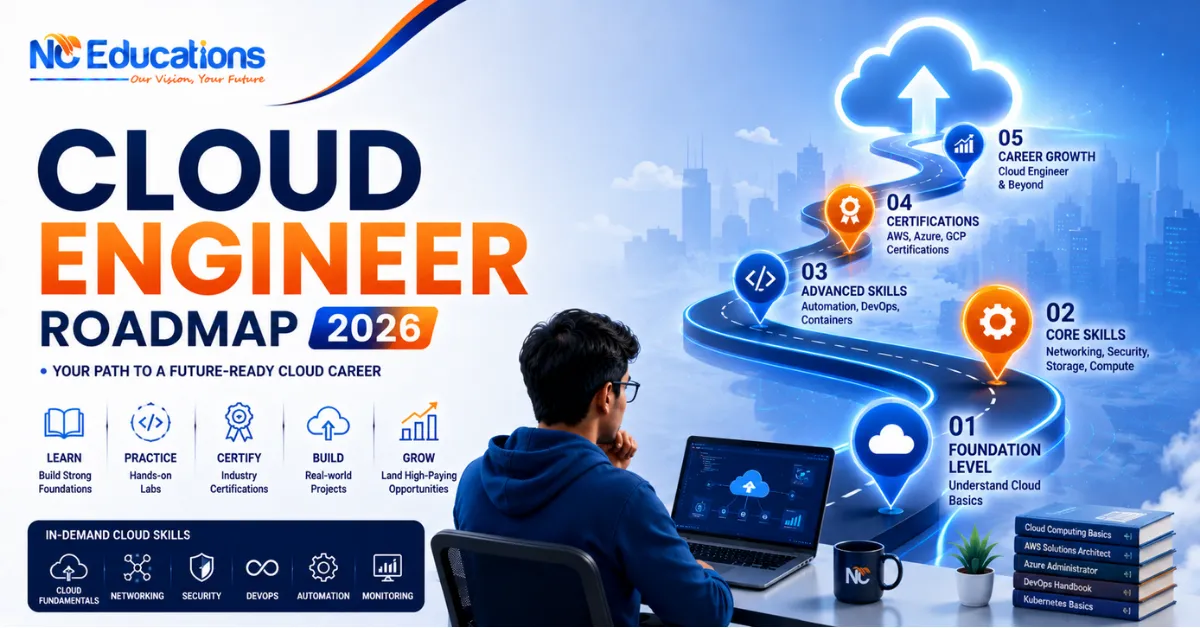
Cloud Engineer Roadmap 2026: Cloud engineering is one of the most in-demand IT careers right now. But not everyone can do it in the right way most beginners get stuck because they don’t have clear starting point. While some jump straight into AWS or Azure certifications first and then learn so many things. Then end up confused after watching random YouTube tutorials with no structure.
That’s exactly having a proper cloud engineer roadmap is so important as it helps you what to learn first, what comes next, and what you can skip until later. This article lays out a step-by-step path to become a cloud engineer. Start from the basics of networking and Linux to choosing a cloud platform, learning DevOps tools, and picking up security skills.
Whether you’re a fresher or switching careers, this roadmap will help you move forward with a clear plan instead of guessing your way through it.
Cloud Engineer Roadmap 2026
A cloud engineer roadmap in 2026 looks a lot different from what it did even three years back. All thanks to AI tools entering the workflow and multi-cloud setups becoming the industry norm rather than the exception. Nowadats companies now expect engineers to know at least one major platform deeply, understand automation, and be comfortable with security basics from day one.
Then how would you prepare? You don’t need to learn everything at once. This roadmap is built in layers whic is starting from the fundamentals, then moving into platform-specific skills, and finally into advanced territory like DevOps and security. So that you build a strong base before jumping into the tougher stuff.
1. Foundation Fundamentals of Cloud Engineering
You need to learn basics and be comfortable with its common terms before touching any cloud platform. This means getting comfortable with how computers, networks, and servers actually talk to each other. Learning the basic networking concepts like IP addresses, DNS, and firewalls.
Chosse a scripting language, curretly Python and Bash are good. Then understand what virtualisation means? and how data centres function behind the scenes. This stage feels boring to a lot of beginners because there’s no flashy dashboard involved, but skipping it is exactly why many people struggle later when concepts like VPCs or load balancers suddenly stop making sense.
2. Choosing A Cloud Platform
This is usually where people get stuck overthinking. AWS, Azure, and Google Cloud are the three big names, and honestly, the core concepts across all three are pretty similar once you dig in. AWS still holds the largest market share and has the most job openings in India, which makes it a safe first pick for most beginners.
Azure is a strong choice if you’re eyeing companies that run on Microsoft tools, since a lot of enterprise clients in India use it. Google Cloud is smaller in comparison but growing fast in data and AI-heavy roles. Pick one, go deep, and you can always pick up a second platform later – the fundamentals carry over.
3. Cloud Fundamentals
Once you’ve picked a platform, spend real time understanding the core building blocks instead of rushing to certifications. Learn what compute, storage, and networking mean in a cloud context – things like virtual machines, object storage, and virtual private networks. Get familiar with the pricing models because cost management is a genuine skill employers care about.
Understand regions and availability zones, and why companies spread their infrastructure across them. Most free-tier accounts from AWS or Azure let you practice this hands-on without spending money, so actually build small projects instead of just watching videos.
4. Linux Cloud Administration
Here’s something a lot of beginners don’t expect – most cloud servers run on Linux, not Windows. So if you’re not comfortable navigating a Linux terminal, you’re going to struggle no matter how many cloud concepts you memorise. Learn basic commands for file handling, permissions, and process management.
Get used to SSH-ing into remote servers and troubleshooting issues without a graphical interface. Package managers, cron jobs, and shell scripting also fall under this bucket. This skill alone separates candidates who can only talk theory from those who can actually manage a live server when something breaks at 2 AM.
5. DevOps & Administration
Cloud engineering and DevOps overlap a lot these days, so employers usually expect at least basic exposure here. Learn about CI/CD pipelines and how tools like Jenkins or GitHub Actions automate code deployment. Get hands-on with Docker for containerization and understand why companies are moving away from traditional deployment methods.
Kubernetes is the next natural step once Docker feels comfortable, since most large-scale systems run containerised workloads through it. Infrastructure as Code tools like Terraform are also worth picking up, because manually configuring servers just doesn’t scale in real production environments anymore.
6. Cloud Security
This part often gets ignored by beginners chasing flashy skills, but it’s one of the most valued areas by recruiters. Learn Identity and Access Management basics – who can access what, and why least-privilege access matters. Understand encryption, both for data at rest and data in transit. Get familiar with security groups, network access control lists, and how to spot misconfigurations that leave systems exposed.
Compliance frameworks are also worth a glance if you’re aiming for enterprise or fintech roles. Security isn’t a separate specialisation anymore – it’s baked into every cloud engineer’s daily responsibilities now.
7. Advanced Cloud Skills
Once the basics are solid, this is where you start standing out from the crowd. Look into multi-cloud and hybrid cloud setups, since many companies now avoid relying on a single provider. Learn cost optimisation strategies, because businesses constantly want to cut cloud spending without hurting performance.
Explore serverless computing through services like AWS Lambda or Azure Functions. Monitoring and logging tools like CloudWatch or Prometheus also matter here, since keeping systems healthy is as important as building them. This stage is less about learning new tools and more about applying everything with real judgment.
Cloud Engineering Roadmap for Beginners
If you are a fresher or someone who have zero knowledge of Cloud or IT field and wanted to make a career out of it. Then this section will help in this, below we have mentioned the Cloud Engineering Roadmap for absolute beginners.
1. Learn Computer Fundamentals
- Start learning the computer networks, operating systems, and how the internet works.
- Then learn basic Linux commands and Windows administration.
2. Learn Networking
- After covering up the basics of computer move to study IP addresses, DNS, HTTP/HTTPS, VPNs, firewalls, and subnets.
- Give proper time to this as it is going to be your base for future.
3. Learn One Cloud Platform
Now its time for you to choose a cloud platform out of the major 3:
- AWS (Amazon Web Services)
- Microsoft Azure
- Google Cloud Platform (GCP)
Learn their virtual machines, storage, databases, IAM, networking services, prices and more.
4. Learn Scripting
- Now start learning a programming language you can go with Python or Bash as their as most common for scripting.
- Now use your learning and automate simple tasks using scripts.
5. Learn DevOps Tools
It’s time to go advance and start learning the DevOps tools.
- Start with Git and GitHub for version control.
- Then move to learning of Docker for containers.
- Then Terraform for Infrastructure as Code.
- Then CI/CD pipelines for automated deployments.
- Then look for any updates or anything addittional from community or mentors.
6. Practice Hands-On Projects
The most important part of the Network Engineer study is practical experience. It is a role that requires you to do the actual work therefore you are needed to do a proper practice on hand on labs, projects.
- You can host a static website on cloud storage to learn and show your cloud skills in CV and interview.
- You can deploy a web application on a virtual machine to learn, understand and have hands on experience rather than watching on youtube videos.
- You can create multiple requirement based cloud infrastructure using Terraform.
- You have to set up multiple monitoring and alerts for different needs.
7. Learn Security and Monitoring
- You need to learn cloud security and access control to understand how to protect cloud resources, manage user permissions, and prevent unauthorized access.
- You can practice backups and logging to understand how to recover data, monitor cloud activities, and troubleshoot errors.
- You can learn cost optimization to understand how to reduce cloud expenses and use resources efficiently in real-world projects.
8. Prepare for Jobs
- You can build a GitHub portfolio by uploading your cloud projects, scripts, and Terraform files to showcase your practical skills on your CV and during interviews.
- You can prepare for cloud-related interviews by practicing technical questions, explaining your projects, and understanding real-world cloud scenarios to improve your confidence.
- You can earn certifications like AWS Certified Cloud Practitioner or Azure Fundamentals to validate your cloud knowledge and strengthen your CV when applying for entry-level cloud jobs.
Tip: Cover the basics as mentioned above then follow the rest from this whole article to achieve top job profiles.
Azure Cloud Engineer Roadmap 2026
If you’re leaning towards Microsoft’s ecosystem, the Azure path has its own structure worth following closely, especially since a lot of Indian enterprises already run on Azure.
- You need to understand Azure’s core services – Virtual Machines, Blob Storage, and Virtual Networks
- Then get comfortable with Azure Active Directory for identity management
- Learn Azure Resource Manager and how resource groups are organised
- Practice deploying and managing App Services for web applications
- Explore Azure DevOps for CI/CD pipelines
- Get hands-on with Azure Monitor for tracking performance and logs
- Work towards the AZ-900 (fundamentals) and then AZ-104 (administrator) certifications
- Build small projects using the Azure free-tier account
AWS Cloud Engineer Roadmap 2026
AWS remains the most in-demand cloud skill in job listings across India, so this path is worth following if you want the widest range of opportunities.
- Start with EC2, S3, and IAM – these three form the foundation of almost everything else
- Learn VPC networking and how AWS structures its regions and availability zones
- Get hands-on with RDS for managed databases and understand when to use them
- Explore Lambda for serverless computing basics
- Learn CloudFormation or Terraform for infrastructure automation
- Practice monitoring using CloudWatch
- Work towards AWS Certified Cloud Practitioner, then AWS Certified Solutions Architect – Associate
- Build at least two to three real projects to showcase during interviews
Why NC Educations is the Right Partner During Your Cloud Engineering Path?
Following a roadmap on your own is one thing, but actually sticking to it consistently is where most people fall behind. NC Educations bridges that gap by giving you
- A structured, mentor-led training instead of leaving you to figure things out from scattered videos.
- You get hands-on labs, real project exposure, and guidance from trainers who’ve actually worked in the industry, not just people reading off slides.
- Doubt-clearing sessions, placement support, and a curriculum that’s updated with what companies are actually hiring for right now make a real difference when you’re trying to break into cloud engineering without wasting a year figuring it out alone.
FAQs Related to Cloud Engineering Roadmap 2026
Qurestion: What is L1, L2, L3 cloud engineer?
Answer: These are support experience levels – L1 handles basic monitoring and first-level fixes, L2 tackles more complex technical issues, and L3 is senior-level, handling critical architecture and escalations.
Qurestion: Will AI replace cloud engineer?
Answer: Not really, but the role is shifting – AI is automating repetitive tasks like monitoring, so engineers now need to focus more on architecture, security, and problem-solving.
Qurestion: Is a cloud engineer high paying?
Answer: Yes, it’s among the better-paying tech roles in India, especially with a year or two of experience and a relevant certification.
Question: Can I become a cloud engineer in 6 months?
Answer: It’s possible with consistent effort, especially with some IT background, though becoming fully job-ready with real project experience usually takes a bit longer.
Related Posts