
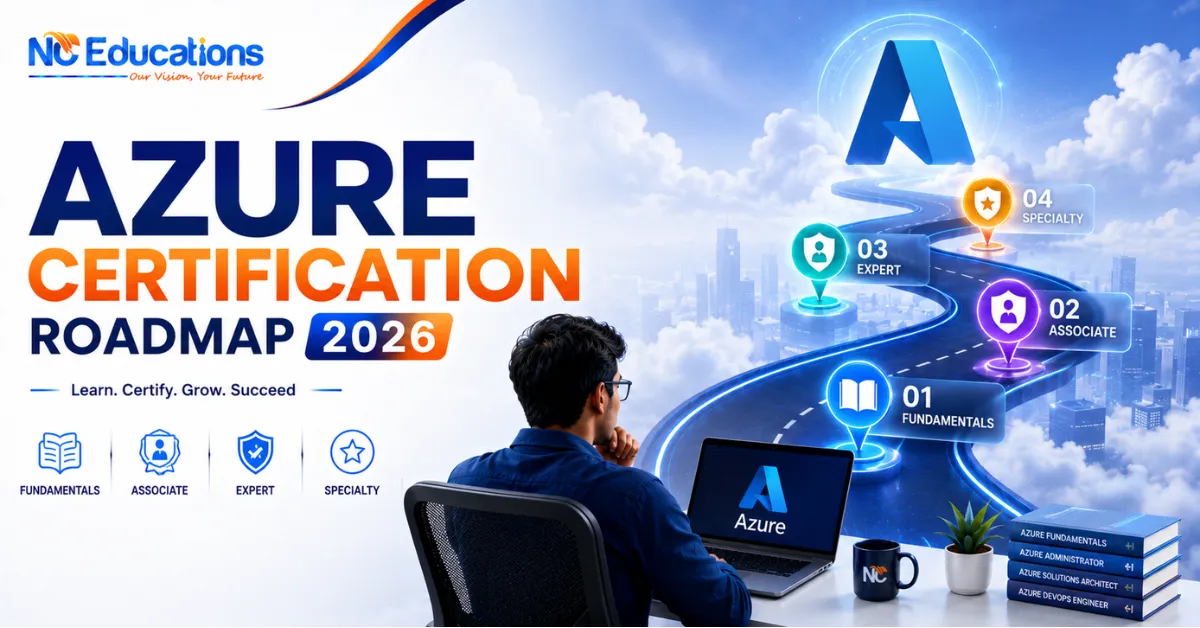
Azure Certification Roadmap 2026: Cloud cmoputing is in trend than ever before and Azure has become an important platform for professionals building careers in cloud, IT, development, data, security, and AI. But for beginners starting career with Azure cloud workspace in 2026 can feel confusing. Microsoft offers certifications at different levels and for different career paths, so choosing the right one can be difficult.
There are also new areas such as AI, automation, and cloud-native technologies to consider. This makes it important to understand what you should learn first, which certification matches your career goal, and when you should move to the next level. That is why we (NC Educations) created this Azure Certification Roadmap 2026.
It gives you a clear path from the basics to advanced Azure certifications, along with the skills, hands-on practice, and career options you should consider at each stage.
Azure Certification Roadmap 2026
This Azure certification roadmap for 2026 follows a proper structured career path following Microsoft’s study guide. It includes:
- Pre-skills
- Azure certifications list and what to choose for your career goal
- Cost of study and exams
- Time duration required
- Lab practices
- Real world scenario based working
- AI integration & automation
- Career Guide
- Educational Background and more
AZ-900 is still a useful starting point for beginners who are new to Azure and cloud computing. However, passing a fundamentals exam alone is not enough to build a cloud career. You also need practical knowledge of networking, operating systems, security, cloud services, and basic automation.
AI is becoming an important part of the Azure ecosystem, but you do not need advanced AI skills before starting your Azure journey. The amount of AI knowledge you need depends on the career path you choose. For example, an Azure AI professional will need much deeper AI knowledge than someone working primarily in Azure administration or networking.
Download Now the Microsoft Azure Certification Roadmap 2026
Therefore you need a proper path to begin your career with. Study the below step by step path nd follow as it or you can edit it as per your career goals.
1. Build Your Prerequisite Skills and Learn Azure Fundamentals
Before preparing for an Azure certification, it helps to understand the basic concepts behind cloud computing and IT infrastructure. You do not need to be an expert, but having these fundamentals will make the certification material much easier to understand.
Start with basic networking concepts such as IP addresses, DNS, TCP/IP, ports, and virtual networks. You should also have a basic understanding of operating systems, virtualization, storage, databases, and security.
Once these concepts are clear, become familiar with Azure itself. Learn how subscriptions, resource groups, regions, resources, and the Azure portal work. Basic experience with Azure CLI or PowerShell can also be useful as you move toward more technical certifications. Then go for Azure AZ-900 or AI-900 certifications.
2. Choose Your Azure Career Path
After learning the fundamentals, the next step is to choose a certification based on the type of work you want to do. You do not need to complete every Azure certification. Choose one path, build practical skills around it, and then decide whether an advanced certification makes sense for your career.
Azure Certification and their paths include:
| Certification | Best Suited For |
| Azure Administrator Associate (AZ-104) | Those who enjoy managing and maintaining Azure infrastructure. |
| Azure Developer Associate (AZ-204) | Developers building and deploying applications on Azure. |
| Azure Solutions Architect Expert (AZ-305) | Engineers designing scalable, secure cloud solutions. |
| Azure Security Engineer Associate (AZ-500) | Those focused on securing Azure environments. |
| Fabric Data Engineer Associate (DP-700) | Those interested in data pipelines and analytics on Azure. |
1. Azure Administration Associate
This certification, based on the AZ-104 exam, focuses on the day-to-day management of Azure resources, such as virtual machines, storage accounts, virtual networks, and identity management. It is a practical, hands-on exam, so you need to know how to actually configure and manage Azure environments.
Not just know the names of different services. This path is a good fit for people who enjoy operational work and want to move into infrastructure or system administration roles instead of development or architecture.
2. Azure Developer Associate
The AZ-204 exam is designed for people with a coding background who want to develop and deploy applications on Azure. It covers topics like Azure Functions, App Services, storage integration, and securing applications with Azure Active Directory.
You should be comfortable writing code that works with Azure APIs and troubleshooting application performance issues. This certification is a good choice for software developers who want to move into cloud-native development roles in the Microsoft ecosystem.
3. Azure Solutions Architect Expert
Don’t let the “expert” label confuse you. AZ-305 is often taken after gaining some associate-level experience, and it focuses on designing complete Azure solutions instead of managing individual services. You’ll need to understand how to design solutions for scalability, security, and cost efficiency across compute, networking, storage, and identity.
This certification is highly valued by employers because it shows that you can think beyond individual services and design systems that can work well in real production environments.
4. Azure Security Engineer Associate
The AZ-500 exam is for people who want to specialise in securing Azure environments. It covers identity and access management, platform protection, security operations, and data and application security.
As companies now give more importance to compliance and data protection, this certification has become more valuable. It is a good choice for people who enjoy the security side of cloud work more than general infrastructure or development tasks.
5. Azure Data Engineer Associate
DP-203 is for people who want to work with data pipelines, storage, and analytics on Azure. It covers services like Azure Synapse Analytics, Data Factory, and Azure Databricks, along with designing efficient and secure data solutions.
As data and AI workloads are growing quickly, this certification is becoming more popular. It is a good choice if you are more interested in working with large datasets than general cloud infrastructure.
3. Advance to professional level
Once you have cleared an associate certification and gained some real project experience, moving to expert-level exams is the natural next step. These exams are harder, require strong hands-on knowledge, and are valued by employers because they are difficult to clear without practical experience. Azure currently has two major expert-level certifications worth targeting:
| Certification | Focus Area |
| Azure Solutions Architect Expert (AZ-305) | Advanced solution design, governance, and migration planning |
| Azure DevOps Engineer Expert (AZ-400) | Automating deployment pipelines, monitoring, and infrastructure at scale |
Choose a speciality to stand out
Specialty certifications aren’t mandatory, but they’re a strong way to show deep expertise in a specific area once your foundation is solid. These are usually pursued by people who already know exactly which niche they want to work in.
| Specialty Certification | Focus Area |
| Microsoft Certified: Cybersecurity Architect Expert (SC-100) | Designing security strategies across Azure environments |
| Microsoft Certified: Identity and Access Administrator Associate (SC-300) | Managing identity and access solutions |
| Microsoft Certified: Azure for SAP Workloads Speciality | Running and managing SAP workloads on Azure |
| Microsoft Certified: Azure Network Engineer Associate (AZ-700) | Designing and implementing Azure networking solutions |
Azure Certification Roadmap For Developers
If you are a CSE begineer or a software developer looking to build your career in cloud computing using microsoft Azure platform. Then this Azure DevOps roadmap is a step by step guide to begin your journey. You don’t need to learn everything or waste time on explore every content. Follow this Azure Certification Roadmap For Developers step by step and focus on practical learning.
Step 1: Understand the Basics of Azure
You can start by learning what cloud computing is and how Microsoft Azure works. Understanding the virtual machines, storage, networking, databases, and resource groups.
Step 2: Start with Azure Fundamentals
Either learn the azure fundamentals or prepare for the AZ-900: Microsoft Azure Fundamentals certification. It helps you understand cloud concepts, Azure services, security, pricing, and governance. Also you will get a proper test for your knowledge, learning and understading. After earning this certification you can also start working while learning rest.
Step 3: Learn Azure Development
Once your AZ-900 level basics are clear, you can move towards AZ-204: Developing Solutions for Microsoft Azure. In this you have to learn how to build, deploy, and maintain cloud-based applications using Azure services.
Step 4: Practise with Real Projects
Now its time to put a little more efforts and shifts to work on projects from solely learning. Put your skills and knowledge into the actions.
- Deploy a web application using Azure App Service and connect your application to Azure SQL Database.
- Also build an API using Azure Functions and store files using Azure Blob Storage.
- Then look for any projects on Github in which you can contribute your skills.
Step 5: Learn Developer Tools
Get familiar with GitHub, Azure DevOps, CI/CD pipelines, Docker, and application monitoring. These are going to be your long term friends in network engineering field.
Step 6: Prepare for Certification and Jobs
Now practice for getting a job in your domain. Start with:
- Taking practise mock tests through online websites.
- Revise important concepts and strengthen your weak areas.
- Add your projects and certifications to your CV and LinkedIn profile.
How NC Educations Helps You in Your Azure Journey?
Preparing for Azure certifications on your own can get confusing fast, especially with how often Microsoft updates its exam patterns. NC Educations offers structured, mentor-led training which is built around the current official syllabus. So you will study what’s actually relevant. You get hands-on lab access, real Azure environments to practice in, and guidance from industry expert.
You will learn from our expert trainers who’ve worked with these tools in live projects rather than just teaching from slides. With doubt-clearing sessions, mock tests, and placement support included, you get a much clearer and faster path to certification than trying to piece everything together from scattered online resources.
FAQs Related to Azure Roadmap 2026
Question: Is AZ-900 difficult to pass?
Answer: No, AZ-900 is considered one of the easier Azure exams since it focuses on fundamental cloud concepts rather than great technical skills.
Question: Are DP 203 and DP 700 the same?
Answer: No, DP-700 is successor of DP 203 (it is retired on 31 March 2025). DEP 700 focuses on data engineering with Microsoft Fabric.
Question: Which is better, SC 200 or AZ 500?
Answer: It depends on your goal, SC-200 focuses on security operations and threat response, while AZ-500 covers broader Azure security implementation.
Question: Can I take AZ 104 directly?
Answer: Yes, Microsoft Azure AZ-104 doesn’t require AZ-900 first, though having the fundamentals down makes the associate-level content easier to grasp.
Related Posts