
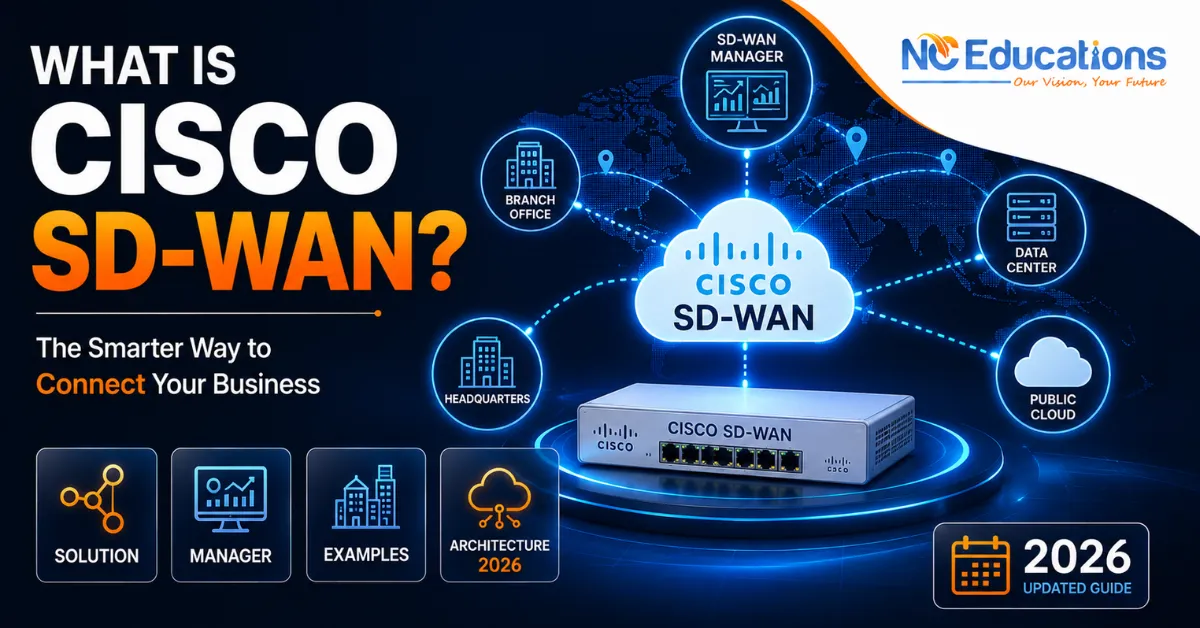
What is Cisco SD WAN?: Cisco SD WAN is a software structure used to manage large network area. When networking teams keep running into the same wall with traditional WANs through MPLS which is reliable but expensive, broadband is cheap but unpredictable, and every application traffic ends up backhauled through a data centre that adds latency nobody asked for.
Cisco SD-WAN was built to fix exactly that problem, and understanding how it actually works. Understanding this matters if you’re studying for CCNP Enterprise or CCIE Enterprise Infrastructure, where SD-WAN is a named blueprint domain, or if you’re simply trying to keep up with where enterprise networking is heading.
This guide walks through what Cisco SD-WAN actually is, how its architecture fits together, and why it’s become one of the most in-demand skills in enterprise networking right now.
Cisco SD Wan Highlights 2026
| Category | Details |
| Software / Solution |
Cisco Catalyst SD-WAN
|
| Full Form |
Software-Defined Wide Area Network
|
| Technology |
Software Defined Wide Area Networking (SD-WAN)
|
| Current Exam |
300-415 ENSDWI v1.2
|
| Exam Name |
Implementing Cisco Catalyst SD-WAN Solutions
|
| Certification |
Cisco Certified Specialist – Enterprise SD-WAN Implementation
|
| Related Certification |
CCNP Enterprise – Concentration Exam
|
| Key Topics |
SD-WAN architecture, controller deployment, WAN Edge deployment, policies, security, QoS, multicast, management and operations
|
| Major Components |
SD-WAN Validator, SD-WAN Manager, SD-WAN Controller, WAN Edge
|
| Certification Validity | 3 years |
What Is Cisco SD-WAN?
Cisco SD-WAN is a software used to manage wide area networking management and it separates network control from the underlying transport, letting organisations connect branches, data centres, and cloud applications over any combination of MPLS, broadband, or LTE – while managing the entire network centrally instead of device by device. It replaces the rigid, hardware-heavy WAN model with one that’s programmable, application-aware, and built to route traffic based on real-time performance rather than fixed paths.
In practical terms, it means a branch office can use a mix of a private MPLS circuit and ordinary internet broadband at the same time, actively, with business-critical traffic automatically steered toward whichever path is currently performing best – instead of broadband sitting idle as a backup link that only kicks in when MPLS fails.
Why Cisco Built SD-WAN?
Traditional enterprise WANs typically relied on MPLS circuits, often paired with internet or LTE in an active/backup arrangement, with internet-bound traffic backhauled to a central data centre for security inspection. That model runs into real problems as cloud adoption grows: insufficient bandwidth, high MPLS costs, poor SaaS performance, slow rollout of policy changes, and limited visibility into how applications are actually performing.
Cisco SD-WAN addresses this by fully integrating routing, security, centralised policy, and orchestration into one overlay – multitenant, cloud-delivered, automated, and application-aware, with the ability to mix transport types in an active-active fashion rather than active-backup.
Cisco SD Wan: Four-Plane Architecture
Cisco Catalyst SD-WAN is built around four separate but connected planes, each handling a distinct job:
- Orchestration plane: It automatically onboards new SD-WAN routers into the network overlay.
- Management plane: It handles centralised configuration and monitoring.
- Control plane: This builds and maintains the network topology and decides where traffic should flow.
- Data plane: It forwards packets according to the decisions made by the control plane.
Using SD Wan and splitting network this way is what makes central management, automation, and rapid policy changes possible. A router doesn’t need to independently work out the whole topology, it just needs to talk to the control plane and forward traffic accordingly.
Core Components of Cisco SD-WAN
Cisco rebranded its SD-WAN component names as part of the shift to “Cisco Catalyst SD-WAN” branding. If you’ve seen older guides referencing vManage, vSmart, and vBond, those are the same components with renamed. Here’s the current mapping, straight from Cisco’s own design guide:
| Current Name | Legacy Name | Plane | What It Does |
| SD-WAN Manager | vManage | Management | Centralised GUI for monitoring, configuring, and maintaining every SD-WAN device – a single pane of glass for Day 0, Day 1, and Day 2 operations |
| SD-WAN Controller | vSmart | Control | Maintains secure connections to every WAN Edge router, distributes routes and policy via the Overlay Management Protocol (OMP), and acts like a route reflector |
| SD-WAN Validator | vBond | Orchestration | Handles initial authentication of WAN Edge devices and coordinates connectivity between the Manager, Controller, and WAN Edge routers – also plays a key role in NAT traversal |
| WAN Edge router | vEdge / cEdge | Data | The physical or virtual router at each site that forwards traffic, handles encryption, QoS, and runs routing protocols like BGP and OSPF |
How SD Wan Actually Works?
Or How it brings a router into the network? Here’s the simple sequence of how a new WAN Edge router joins the SD-WAN overlay:
- The router authenticates with the SD-WAN Validator over an encrypted connection.
- Once It authenticated, the validator hands the router the addresses of the SD-WAN Manager and controller and tells them a new router is joining.
- The router connects to the SD-WAN Manager, which pushes its configuration, and drops its temporary connection to the Validator.
- The router connects to the SD-WAN Controller(s), learns the network’s routes and policies over the Overlay Management Protocol (OMP), and starts forming secure IPsec tunnels to other sites.
This can happen with zero manual configuration on-site – a router shipped to a new branch can be plugged in, powered on, and automatically join the network through Zero-Touch Provisioning or Plug-and-Play, which is a big part of why SD-WAN cuts deployment time so dramatically compared to traditional WAN rollouts.
What Cisco SD-WAN Is Actually Used For?
- It is used to secure, automated WAN connectivity between branches, data centres, and public/private cloud, with zero-touch provisioning for new sites.
- It helps in application performance optimisation by steering traffic away from congested or degraded paths in real time based on measured loss, latency, and jitter.
- It secures direct internet access by letting branch traffic exit locally to the internet instead of being backhauled to a central data centre, without giving up security inspection.
- It if useful in multicloud connectivity by connecting branches directly to SaaS and IaaS platforms like AWS, Azure, and Microsoft 365 over the best-performing path available.
What is Cisco SD Wan Manager?
Cisco Catalyst SD-WAN Manager (formerly known as vManage) is a software and a a centralized management system. It is a type of dashboard which is used to monitor, configure, manage and operate a complete Cisco SD-WAN network from system from a single location.
The key functions of Cisco SD Wan Manager are:
- Single Pane of Glass: It provides an intuitive web dashboard to monitor health, performance and topology of an entire network system.
- Centralized Configuration: It allows administrators to configure and manage network devices from one central location instead of configuring each device individually.
- Policy Management: It allows administrators to create and apply network policies from a central platform to control traffic and improve application performance.
- Monitoring and Analytics: It provides real-time visibility into network health, performance, traffic, and application behavior to help identify and troubleshoot issues.
- API-Driven Architecture: It provides APIs that allow organizations to automate network tasks and integrate SD-WAN with other tools and platforms.
Cisco SD-WAN Engineer Salary in India
Salary figures for SD-WAN-specific roles vary a lot depending on the source and sample size, so treat these as directional ranges rather than fixed numbers.
| Source | Sample Basis | Reported Range/Average |
| Glassdoor (“Network Engineer – SDWAN” role) | 12 self-reported salaries | Average ~₹14.5 lakh/year; typical range ₹10.1–18.7 lakh/year; top earners up to ~₹1.18 crore/year (small sample, likely one outlier skewing the top end) |
| 6figr.com (employees with SDWAN skill listed) | 24 profiles | Average ~₹26.2 lakh/year; typical range ₹21.1–44.5 lakh/year; top 10% above ₹42.5 lakh/year |
| Job market observation | Postings reviewed on Glassdoor India | SD-WAN engineer roles commonly list CCNP or CCIE as preferred/required, alongside 3+ years of routing and SD-WAN provisioning experience |
Why Learn Cisco SD-WAN From NC Educations?
Cisco SD-WAN is not a easy topic that anyone can fully learn by reading online or pdfs. It needs knowledge of planes, the certificate-based authentication, the OMP routing behaviour and lab practices. All this is a hard part for self study as you can stuck on a doubt and no lab practice resource. That’s where NC Educations’ Cisco SD WAN 300-415 training comes in play.
This training programme is built on official Cisco’s guide and documentation. You will learn from a CCIER level expert industry trainer. The training itlse treats SD-WAN as a hands-on skill, not a theory. You will be working through real onboarding flows, real policy configuration, and real troubleshooting scenarios, guided by people who’ve actually worked with this technology in production networks.
You will have weekly doubt sessions, 24/7 lab access and lectures recording access. You will have trainers along with counsellors for guiding. You get acces to NC blogs, news about upcomig trends, AI Automation and more wtih NC Eduacations. The training also provide 100% placement assistance from Resume buuilding, Linkedin profile building, Interview preparation with mock interviews session, Job reference and more.
FAQs Question Related to Cisco SD WAN
Question: What is the purpose of an SD-WAN?
Answer: SD-WAN helps businesses connect and manage multiple locations over the internet more efficiently, securely, and reliably.
Question: What is the concept of SD-WAN?
Answer: The concept of Cisco’s SD WAN is a software based network architecture that connect, manage and route multipoint network traffic over the internet.
Question: What is the difference between SD-WAN and WAN?
Answer: A WAN is a network that connects different locations over long distances. While SD-WAN is a software based technology that is used to intelligently manages and optimizes those WAN connections.
Question: Is Cisco SD-WAN the same as vManage?
Answer:
Question: Is Cisco SD-WAN the same as vManage?
Answer: No. vManage is the old name for what’s now called SD-WAN Manager – one component within the broader Cisco SD-WAN solution, not the solution itself.
Question: Do I need to know SD-WAN for CCNP Enterprise?
Answer: Yes. SD-WAN is covered as part of the ENCOR 350-401 exam and is one of the five weighted domains in the CCIE Enterprise Infrastructure lab blueprint.
Question: What’s the difference between vEdge and cEdge routers?
Answer: Both are WAN Edge router types. vEdge runs Viptela OS; cEdge runs Cisco IOS XE with SD-WAN capability. Cisco’s current hardware direction has moved toward IOS XE-based (cEdge) devices.
Can Cisco SD-WAN use broadband internet instead of MPLS?
Answer: Yes – that’s one of its core value propositions. It can combine MPLS and broadband (or LTE) in an active-active setup, using application-aware routing to send traffic over whichever transport is performing best.
Question: Is Cisco SD-WAN a good skill to specialise in?
Answer: It’s currently one of the more in-demand skills in enterprise networking, since most large organisations are actively migrating away from legacy WAN architectures, and it’s a required topic for both CCNP Enterprise and CCIE Enterprise Infrastructure.
Also Read
12 thoughts on “What is Cisco SD WAN?: Solution, Manager, Examples, Architecture 2026”